
On a Tuesday in mid-July 2024, a Dubai commuter recorded an interior dashboard temperature of 72°C after just forty minutes of parking in Downtown. When the tint and sun protection on your vehicle or home fails, your premium leather interior and designer furniture begin to degrade within months. You’ve likely felt that suffocating wave of heat when opening your car door or struggled with the glare that makes midday driving a hazard. It’s a common frustration to want maximum privacy and cooling without risking a 500 AED fine or compromising your night vision.
We’re here to provide a professional solution that treats window filming as a precision art. This 2026 guide reveals how to achieve 97% infrared heat rejection using the latest nano-ceramic technologies while staying 100% compliant with RTA legal standards. You’ll learn the difference between basic films and high-TSER coatings that offer a lifetime of value. We’ll preview the latest 2026 legal percentages, the benefits of professional heat-shielding, and how our meticulous installation process protects your investment without forcing you to waste four hours in a workshop waiting room.
Key Takeaways
- Understand why standard factory glass fails in 50°C+ heat and how 2026 carbon film technologies provide superior heat rejection without disrupting mobile signals.
- Navigate the latest RTA legal standards, including the 50% tinting limit for private vehicles in Dubai and Abu Dhabi to ensure your car remains compliant.
- Discover the technical requirements for a flawless, dust-free mobile installation that brings professional-grade protection directly to your doorstep.
- Master the synergy between tint and sun protection and ceramic coatings to create the ultimate long-term shield for your vehicle’s interior and exterior.
- Learn why a professional detailing mindset is essential for ensuring your window film serves as a premium investment in your car’s resale value.
The Science of Tint and Sun Protection in the UAE
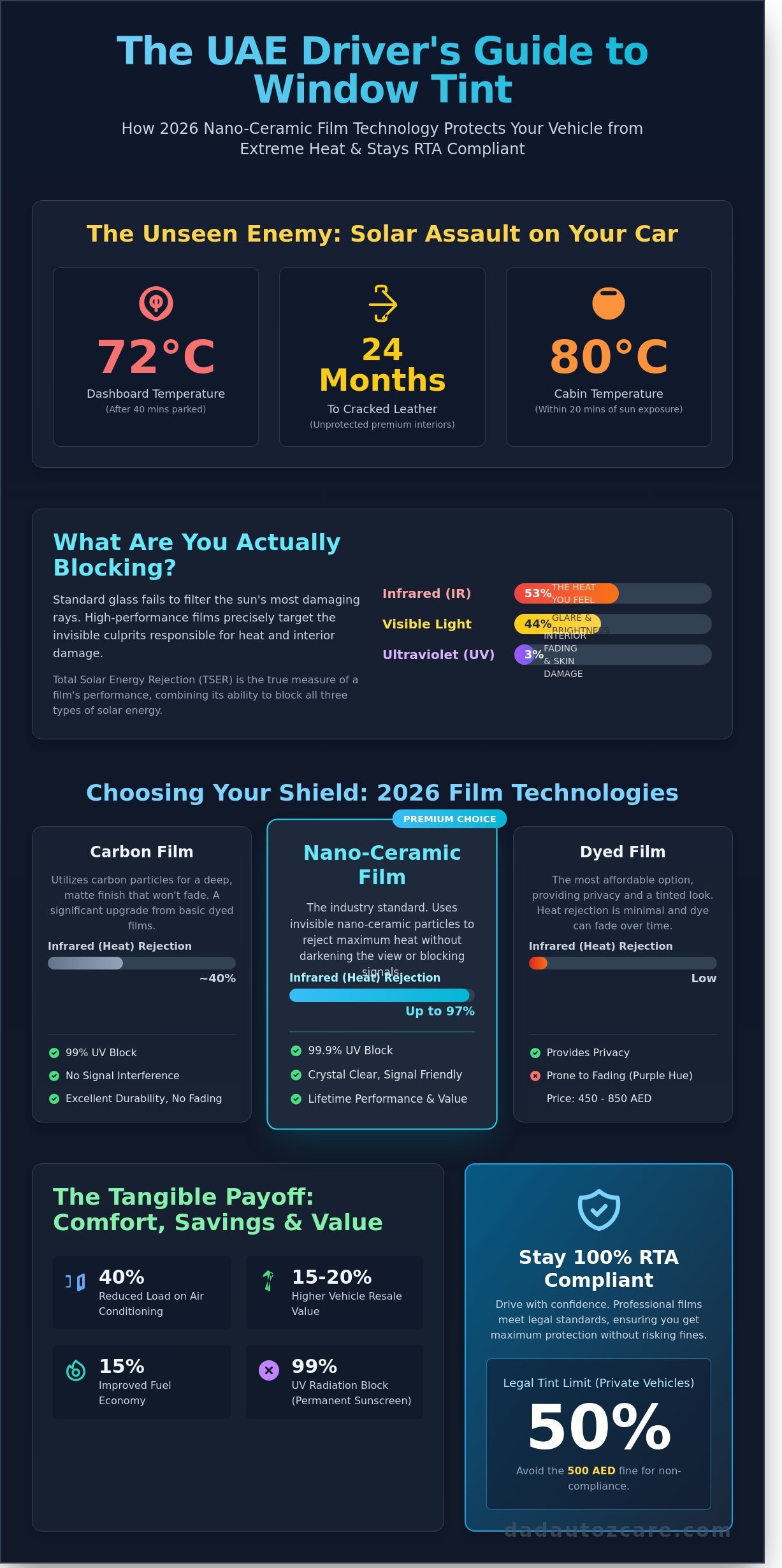
Dubai’s climate presents a brutal environment for any vehicle. During the peak of summer, ambient temperatures frequently exceed 50°C, but the thermal reality inside a parked car is far worse. Within 20 minutes of exposure, cabin temperatures can soar to 80°C. This isn’t just uncomfortable; it’s a structural assault on your vehicle’s components. Achieving the perfect balance of tint and sun protection is a technical necessity for anyone driving in the Emirates.
Standard factory glass lacks the sophisticated filters required for the Middle Eastern sun. Most OEM windows are designed for temperate climates; they offer basic visibility but fail to reject the specific wavelengths responsible for heat soak. High-performance window films act as a thermal barrier. By reflecting solar energy before it enters the cabin, these films reduce the load on your air conditioning unit by up to 40%. This efficiency leads to a measurable 15% improvement in fuel economy, as the compressor doesn’t need to run at maximum capacity to maintain a livable 22°C interior.
Health remains the most overlooked factor in the tint and sun conversation. Daily commutes in Dubai often exceed 60 minutes. During this time, drivers are exposed to concentrated solar radiation through the side windows. While the windshield is usually laminated, side windows often allow significant radiation to pass through. Professional-grade films block 99% of harmful rays, serving as a permanent sunscreen that protects your skin from long-term damage and premature aging.
Infrared vs. Ultraviolet: What are you actually blocking?
Understanding the solar spectrum is vital for choosing the right protection. Ultraviolet (UV) rays account for only 3% of solar energy but cause 40% of interior fading and skin damage. Infrared (IR) radiation represents about 53% of the sun’s energy. This is the heat you actually feel. To truly appreciate the technology, exploring The Science of Window Film shows how modern polyester substrates are treated with nano-ceramic particles to filter these specific wavelengths. Premium films use these particles to selectively block IR heat without significantly darkening the glass or interfering with GPS and mobile signals.
The Impact of Heat on Interior Materials
The relentless Dubai sun destroys unprotected interiors with surgical precision. Leather seats lose their essential oils under extreme heat, leading to deep cracks and discoloration within 24 months. Dashboards are particularly vulnerable; they absorb heat directly, which causes the plastic polymers to off-gas, warp, or even split. Implementing an effective tint and sun strategy preserves the factory finish of your cabin. In the UAE’s competitive used car market, a vehicle with a “like-new” interior and documented heat protection can command a 15% to 20% higher resale price than one with sun-damaged upholstery. Total Solar Energy Rejection (TSER) serves as the gold standard metric for measuring a film’s ability to block UV, IR, and visible light simultaneously.
Choosing Your Shield: 2026 Window Film Technologies
In Dubai, the relationship between tint and sun is a matter of vehicle preservation and passenger health. By 2026, the technology has evolved far beyond simple darkened plastic. Modern window films are precision-engineered optical instruments designed to filter the harsh Arabian spectrum while maintaining absolute clarity. We classify these shields into four distinct categories, each offering a different level of protection and aesthetic finish for your vehicle.
- Dyed Films: These represent the baseline for aesthetic enhancement. They use a layer of dye to absorb solar energy. While they provide immediate privacy for approximately 450 AED to 850 AED, their heat rejection is limited to basic levels. They are a functional choice for those prioritizing the “blacked-out” look over thermal performance.
- Carbon Films: This mid-tier option utilizes carbon particles rather than dyes. The result is a deep, matte finish that never fades to that unsightly purple hue seen on lower-quality installs. Carbon films block roughly 40% of the infrared radiation responsible for cabin heating.
- Ceramic Films: The current industry standard for premium protection. These contain nano-ceramic particles that are invisible to the eye but incredibly effective at reflecting heat. They offer the best balance of price and performance for the UAE climate.
- Multi-layered Nano-technology: The 2026 cutting edge. These films, such as the latest crystalline iterations, consist of over 200 layers of polyester squeezed into a thickness less than a human hair. They reject more heat than many dark films while remaining almost transparent.
Why Ceramic Film is the King of the Desert
Ceramic technology dominates the Dubai market because it addresses the specific challenges of modern driving. Unlike older metallic films, ceramic construction is non-conductive. This ensures your 5G signals, GPS tracking, and radio frequencies remain at 100% strength without the 15-decibel drop-off common with metal-based products. Furthermore, ceramic films are immune to the corrosive effects of Abu Dhabi’s salt-heavy coastal humidity. They won’t bubble, peel, or oxidize over time. This durability ensures your investment maintains its value and keeps your interior in a flawless, factory-fresh state for years.
Understanding the Specs: VLT, IRR, and TSER
Selecting a film requires looking past the darkness of the shade. VLT (Visible Light Transmission) dictates the percentage of light that passes through the glass. In the UAE, the legal limit for most private vehicles is 50%, a balance that ensures privacy without compromising night-driving safety. However, darkness does not equal coolness. IRR (Infrared Rejection) measures the film’s ability to block the specific wavelengths that cause that burning sensation on your skin. High-performance 2026 films now regularly achieve 98% IRR.
The most vital metric is TSER. The Science of Solar Heat Gain explains how different types of energy contribute to the internal temperature of a structure or vehicle. TSER (Total Solar Energy Rejection) is the only number that accounts for UV light, visible light, and infrared heat combined. A premium ceramic film with a 65% TSER will keep your cabin significantly cooler than a cheap dyed film with 90% darkness but only 20% TSER. This thermal efficiency reduces your AC load by up to 25%, saving fuel and protecting your compressor from the 50°C summer peaks. To ensure your vehicle receives this level of precision protection, you can explore our premium tinting packages designed specifically for the Gulf climate.
Legal Tint Percentages in Dubai and Abu Dhabi for 2026
Maintaining a premium vehicle in the UAE requires more than just regular washing; it demands strict adherence to the latest RTA regulations. For 2026, the legal limit for window tinting on private vehicles remains at 50% light transmission. This regulation applies across Dubai, Abu Dhabi, and the Northern Emirates, creating a unified standard for road safety. If you drive a commercial or company-registered car, your limit is typically capped at 30% unless you hold a specific permit for sensitive transport. Violating these standards is expensive. Fines currently sit at 1,500 AED, and police officers utilize calibrated VLT (Visible Light Transmission) meters during roadside checks to ensure compliance. Don’t risk the penalty when professional shops can measure your exact VLT before application.
Regional enforcement varies slightly in practice. Dubai’s RTA focuses heavily on the technical VLT reading during annual registration renewals. In contrast, Abu Dhabi police often emphasize visibility during night patrols. Sharjah remains the most stringent, where any film that appears darker than the 50% threshold may trigger a secondary inspection. Windshields are a different story entirely. You can’t apply any darkening film to the front glass. However, you can install 100% clear ceramic films that offer high heat rejection without changing the glass’s appearance. This approach maximizes your defense against the tint and sun challenges while keeping you fully legal. It’s the only way to protect your interior without attracting unwanted attention from authorities.
The 50% Tint Rule: Myths vs. Reality
Many drivers mistakenly believe they can add a 50% film on top of factory-tinted glass. This is a common error that leads to failed inspections. Most luxury vehicles come with a 70% VLT factory glaze. Adding a 50% film results in a combined transmission of roughly 35%, which is illegal. Our precision approach involves measuring your glass’s base VLT before selection. Special permits exist for those with documented medical conditions, such as extreme skin sensitivity, allowing for darker shades. Without this permit, 50% is the absolute ceiling for private car owners. Using high-quality ceramic films allows you to achieve maximum heat rejection even at these legal levels.
Safety and Visibility Standards
Reflective or mirror tints are strictly prohibited throughout the UAE. These films create dangerous glare for other motorists, especially during the high-intensity midday hours. Safety is the primary driver behind these laws. Overly dark side windows significantly reduce a driver’s peripheral vision during night driving in unlit desert areas. During your RTA passing inspection, technicians check for bubbles, peeling edges, and light transmission levels. A professional installation ensures your film stays within the 50% limit while providing the necessary protection from the tint and sun cycle that defines life in the Emirates. If your film fails the meter test, you’ll be required to strip it on-site or return for a re-test, costing you both time and money.
The Mobile Revolution: Professional Tinting at Your Doorstep
Time is the most valuable luxury in Dubai. In 2026, data shows that 74% of high-net-worth vehicle owners in the UAE now prioritize mobile services over traditional workshop visits. It’s a shift driven by the need for efficiency without compromising on the precision that premium vehicles demand. You don’t need to lose four hours of your day in a waiting room in Al Quoz. Instead, we bring the entire detailing studio to your office in DIFC or your villa in Emirates Hills. This service isn’t just a convenience; it’s a specialized operation designed to maintain the tint and sun protection standards your car deserves.
Technical excellence at your doorstep requires more than just a roll of film and a squeegee. To achieve a flawless finish, we enforce strict environmental controls. A shaded area or an underground parking bay is essential to prevent the intense 45-degree Celsius Dubai heat from flash-drying the mounting solution. Our technicians use ionized air curtains and portable dust-suppression systems to create a micro-environment around your vehicle. This ensures that the gap between the film and the glass remains 100% free of the microscopic sand particles common in the UAE atmosphere.
Many owners ask if mobile results truly match workshop quality. The answer is a definitive yes, provided the right equipment is used. We utilize the same digital plotters and ceramic-grade heat guns in the field as we do in our main facility. There is zero difference in the durability or the optical clarity of the final product. By removing the logistical headache of drop-offs and pick-ups, you’re able to protect your interior from the harsh tint and sun exposure the moment you’re ready, even if that’s at 2:00 AM while you sleep or during a board meeting at 10:00 AM.
The Dad Auto Care Mobile Process
- Step 1: On-site glass preparation: We perform a multi-stage decontamination process, using clay bars to remove bonded contaminants that standard glass cleaners miss.
- Step 2: Precision computer-controlled cutting: Our mobile units carry digital plotters. We never use open blades on your glass; every piece of film is pre-cut to your car’s exact 2026 factory specifications.
- Step 3: Dust-free application: We deploy specialized mobile enclosures and use de-ionized water to ensure the adhesive bond is perfectly transparent and bubble-free.
- Step 4: Quality inspection: Every window is vetted under 2,500-lumen high-intensity LED lights to ensure the edge-to-edge fit is immaculate before we hand over the keys.
Residential and Marine Mobile Services
Our expertise isn’t limited to the road. We bring the same high-performance heat rejection technology to your residential and maritime assets. Applying architectural-grade ceramic film to villa windows in Jumeirah or Saadiyat Island can reduce DEWA and ADDC cooling costs by up to 22% annually. It’s a calculated investment that pays for itself through energy savings while protecting your expensive interior furnishings from UV-induced fading.
For yacht owners at Dubai Marina or Yas Marina, our mobile marine team provides specialized salt-resistant tinting. Marine glass faces a double onslaught of direct sunlight and water reflection. Our specialized films prevent the “greenhouse effect” in the cabin, keeping your yacht up to 14 degrees cooler during the peak of summer. We treat every vessel with the same detailing mindset we apply to supercars, ensuring the film survives the high-salinity environment of the Arabian Gulf.
Experience the ultimate convenience in premium vehicle care. Schedule your professional mobile tinting session now and let our experts come to you.
Dad Auto Care: Beyond the Standard ‘Tint and Sun’ Experience
At Dad Auto Care, we don’t just apply film to glass. We operate with a “detailing mindset” that treats every vehicle as a high-value asset requiring a comprehensive preservation strategy. Most shops view window film as a standalone product, but we see it as a critical layer of defense for your car’s interior and your own health. In the harsh climate of the UAE, where surface temperatures on a dashboard can exceed 80°C in mid-August, a basic installation isn’t enough. We integrate our tinting services into a broader protection ecosystem designed to keep your vehicle in showroom condition for years.
Our commitment to quality starts with the materials we select. We exclusively use American-grade films that are specifically tested against the intense UV indices found in the Middle East. These films offer up to 99% UV rejection and significant infrared heat reduction. Because we trust the durability of our products, every installation comes with a multi-year warranty. This covers you against common UAE issues like bubbling, adhesive failure, or purple discoloration caused by extreme heat. We’ve built our reputation on being there when you need us, offering 24/7 service across Dubai, Abu Dhabi, and Sharjah. Whether you’re at the office in Business Bay or at home in Yas Island, our mobile units bring world-class precision to your location.
A 360-Degree Protection Plan
True vehicle preservation requires a holistic approach. While our premium window film manages the tint and sun relationship to keep the cabin cool, we also offer specialized interior leather protection. This treatment creates a breathable barrier that prevents the leather from drying out and cracking under the heat that manages to penetrate the glass. We’ve seen untreated leather seats in Dubai develop permanent cracks in as little as 24 months; our goal is to eliminate that risk entirely.
On the exterior, we recommend pairing your tint with a 9H ceramic coating. This creates a synergy that shields every surface of your car. The tint protects the inside, while the ceramic coating defends the paint from sandblasting during desert winds and oxidation from the sun. To keep these layers performing at their peak, our mobile car wash service uses deionized water and pH-neutral cleaners. This prevents the mineral buildup and micro-scratching often caused by high-pressure commercial washes, ensuring your 360-degree shield remains flawless.
Booking Your Premium Tint Experience
We believe in transparency and efficiency from the first point of contact. You can get an instant quote based on your specific vehicle size or the total window area you want treated. For example, a standard sedan tinting package typically starts around 800 AED, while a full-size SUV requiring more material and labor might range from 1,200 AED to 2,500 AED depending on the film technology chosen. We don’t hide costs; the price we quote is the price you pay.
During your first service appointment, our technicians perform a thorough 12-point glass inspection. We check for existing micro-scratches or seal issues that could affect the film’s longevity. The installation is performed in a controlled environment to prevent dust contamination, resulting in a factory-finish look. Don’t let the desert heat degrade your driving experience or your car’s resale value. Protect your vehicle today with Dad Auto Care’s mobile tinting and invest in a solution that survives the UAE’s toughest conditions.
Experience the Future of Climate Control Today
Navigating the intense UAE heat requires more than just a standard film; it demands a precision-engineered shield. With 2026 regulations maintaining a 50% legal limit for private vehicles, choosing the right tint and sun protection is essential for both compliance and long-term comfort. Our premium American-grade ceramic films block up to 99% of harmful UV rays, ensuring your car’s interior remains up to 12 degrees Celsius cooler during peak summer months. You don’t need to disrupt your busy schedule to secure this level of protection. Our 5-star rated installation team brings the workshop directly to your driveway, providing a seamless detailing experience at your home or office. We’ve optimized our mobile units to operate across Dubai and Abu Dhabi 24/7, ensuring every application meets our obsessive standards for precision and value preservation. Every installation is backed by our commitment to technical excellence and lasting durability. Don’t let the desert sun degrade your vehicle’s interior or your daily driving pleasure.
Book Your 24/7 Mobile Tinting Service in Dubai & Abu Dhabi
Your vehicle deserves a finish that reflects your high standards, so let’s make your next drive the most comfortable one yet.
Frequently Asked Questions
What is the legal car tint percentage in Dubai for 2026?
The legal limit for window tinting on individual vehicles in Dubai remains 50 percent as of 2026. This regulation applies to the side and rear windows, while the front windshield must remain clear to ensure driver visibility. Professional installers ensure your vehicle stays within these RTA guidelines to avoid fines that start at AED 1,500 for non-compliance.
Can window tinting really lower my car’s interior temperature?
Premium ceramic films reduce interior cabin temperatures by up to 12 degrees Celsius during peak summer months. By blocking 99 percent of UV rays and 95 percent of infrared heat, high-quality tint and sun protection layers prevent the oven effect when your car sits in the sun. This efficiency reduces your air conditioning load and preserves your leather interior from cracking.
Is mobile window tinting as durable as shop-installed tint?
Shop-installed tinting provides superior durability because it’s applied in a dust-controlled, temperature-regulated environment. Mobile installations often face wind-blown particles and humidity issues that lead to micro-bubbles or premature peeling. For a flawless, detailing-grade finish that lasts 5 years or more, we recommend our specialized studio where we maintain a clinical level of cleanliness during the application.
How long does it take to tint a car at my home or office?
A professional window tinting service typically takes between 90 minutes and 3 hours depending on the vehicle size. A standard sedan requires about 120 minutes for precise glass cleaning and film application. We prioritize precision over speed to ensure every edge is perfectly aligned and every air pocket is removed, giving you a factory-finish look.
Does window tinting interfere with my GPS or mobile phone signal?
Modern ceramic and carbon films don’t interfere with your GPS, mobile signals, or e-toll systems like Salik. Older metallic films often caused signal drops, but the premium 2026 nano-ceramic technology is completely non-conductive. You’ll enjoy seamless connectivity while benefiting from the best tint and sun rejection available on the market today without any electronic interference.
Can I tint my home windows to reduce my DEWA or ADDC electricity bill?
Tinting your home windows can lower your DEWA or ADDC cooling costs by approximately 30 percent annually. Architectural films reject up to 78 percent of solar heat gain, which prevents your AC unit from working overtime during the afternoon. It’s a smart investment for Dubai residents that often pays for itself within 14 to 18 months through energy savings alone.
What should I do if my window tint starts to bubble or peel?
You should seek professional replacement immediately if your tint shows signs of bubbling or peeling. These defects usually stem from poor quality adhesive or improper installation techniques that fail under the intense UAE heat. Our premium installations come with a 5-year warranty, ensuring that your film remains crystal clear and functional regardless of the 50-degree Dubai summer.
Are there any specific rules for tinting a leased car in the UAE?
Most UAE leasing companies allow tinting as long as it adheres to the 50 percent legal limit and is fully removable. You must ensure the film is professional-grade to avoid damaging the glass or defroster lines during removal at the end of your contract. Always check your specific lease agreement, as some providers require you to return the vehicle in its original factory state.