
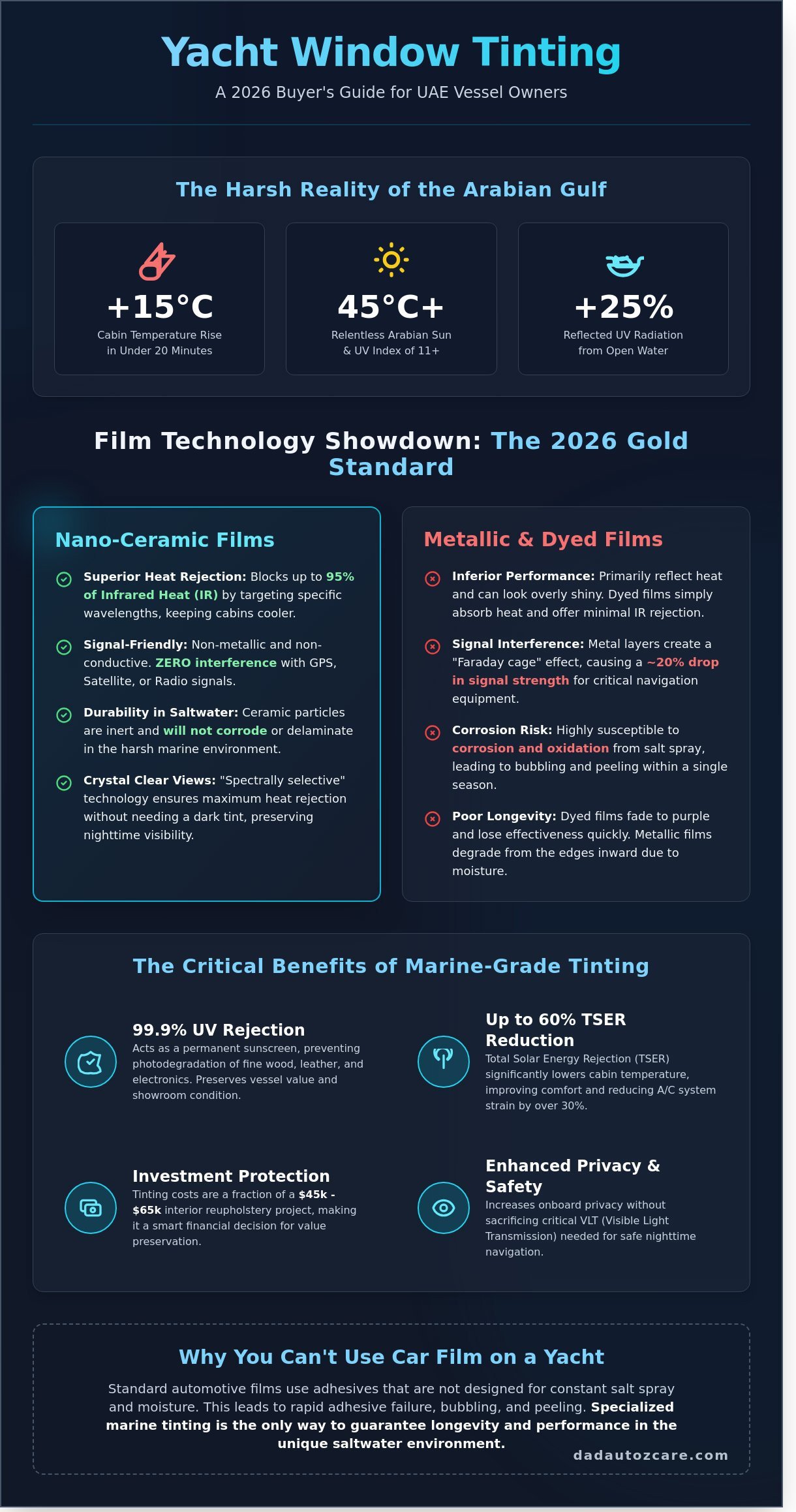
A single summer afternoon in Dubai can raise your yacht’s cabin temperature by 15 degrees Celsius in less than 20 minutes, even with your air conditioning system working at peak capacity. It’s a harsh reality for vessel owners who see their bespoke leather interiors and fine wood finishes fade under the relentless 45°C Arabian sun. You’ve likely experienced that blinding glare off the water that makes midday navigation a constant strain on your eyes. We understand that your yacht is more than a boat; it’s a precision-engineered sanctuary that deserves uncompromising protection. High-end marine window tinting isn’t just about style; it’s a critical layer of defense for your maritime investment.
We agree that luxury shouldn’t come with the discomfort of a sweltering cabin or the sting of skyrocketing fuel bills from overworked cooling systems. This 2026 guide shows you how to achieve a 99% UV block and a 60% reduction in total solar energy heat gain. You’ll learn how advanced ceramic films preserve your interior’s showroom condition while enhancing your onboard privacy. We’ll walk you through the technical specifications of the latest films that ensure your visibility remains sharp during night voyages while keeping your vessel’s aesthetic profile sleek and sophisticated.
Key Takeaways
- Understand why the extreme UV index in the UAE makes specialized protection a necessity for your yacht’s longevity and interior preservation.
- Identify the performance gap between nano-ceramic and metallic films to ensure your vessel benefits from the gold standard in heat rejection.
- Learn why specialized marine window tinting is the only way to prevent adhesive failure caused by the unique salt-water environment.
- Master our 2026 buyer’s framework to select the perfect balance of TSER and VLT for maximum privacy and nighttime navigational safety.
- Discover how professional mobile detailing can restore and protect your vessel’s value directly at major hubs like Dubai Marina and Yas Marina.
What is Marine Window Tinting and Why is it Critical in the UAE?
Marine window tinting isn’t a simple aesthetic upgrade. It’s a precision-engineered, multi-layer polyester film designed specifically to withstand salt spray and constant moisture. Unlike standard automotive films, these maritime versions utilize advanced Window Film Technology to block solar energy without interfering with critical GPS or satellite signals. In Dubai and Abu Dhabi, where the UV index frequently exceeds 11 between May and September, this protection is a baseline requirement for any vessel owner.
Large glass surfaces on modern yachts create a massive greenhouse effect. Solar radiation enters through the windows, hits the interior surfaces, and converts into heat that stays trapped inside the cabin. This process forces air conditioning systems to work 30% harder, leading to increased fuel consumption and mechanical wear. High-quality marine window tinting mitigates this by reflecting solar energy before it ever enters the cabin space.
The Science of Heat Rejection on the Water
Open water acts like a giant mirror. It reflects up to 25% of UV radiation back at your vessel, effectively doubling the heat impact compared to land-based vehicles. You experience two distinct types of heat: visible light and near-infrared (IR) radiation. While visible light accounts for 44% of solar energy, IR radiation carries 53% of the heat you feel on your skin. TSER is the only metric that matters for UAE boat owners because it measures the combined rejection of UV, visible light, and infrared heat in a single percentage.
Protecting Luxury Interiors from UV Degradation
High-end materials like Burmese teak, Italian leather, and sensitive bridge electronics are highly vulnerable to “photodegradation.” Constant exposure to extreme UV levels causes fibers to break down and colors to fade within as little as 12 months in the Arabian Gulf. Premium marine window tinting offers 99.9% UV rejection, serving as a permanent, invisible sunscreen for your cabin.
The financial logic is clear. Professional tinting for a 50ft yacht represents a small fraction of the $45,000 to $65,000 typically required for a full interior reupholstery and wood refinishing project. It’s a strategic investment in value preservation that keeps the vessel in showroom condition. Our detailing mindset ensures that every edge is sealed perfectly to prevent the corrosive sea air from delaminating the film over time.
Advanced Film Technologies: Nano-Ceramic vs. Metallic Tints
Modern yacht owners in the UAE no longer settle for basic aesthetics. The shift toward nano-ceramic technology represents a fundamental upgrade in how we protect maritime assets. While metallic films dominated the market a decade ago, they’ve become a liability in the high-stakes environment of the Persian Gulf. Nano-ceramic films utilize microscopic particles to filter the solar spectrum with surgical precision.
This technology provides a massive leap in heat rejection without compromising visibility. High-end ceramic coatings can block up to 95% of infrared heat. Beyond comfort, health is a primary driver for this upgrade. Following the Skin Cancer Foundation’s recommendation for UV protection is essential when spending hours on deck. These films block 99.9% of harmful UVA and UVB rays, effectively turning your cabin into a safe haven. It’s a precision-engineered barrier that protects both the interior upholstery and your skin.
Why Nano-Ceramic is the King of the Marina
Ceramic films are “spectrally selective.” They identify and block heat-generating wavelengths while allowing visible light to pass through. You don’t need dark, “limo-style” windows to stay cool. This is vital for night navigation in busy ports like Port Rashid. Because ceramic is non-conductive, it won’t corrode. In the Persian Gulf, where salinity levels often exceed 40 parts per thousand, non-metallic materials are the only way to ensure marine window tinting lasts more than a single season. The result is a crystal-clear view that remains stable for years.
The Pitfalls of Traditional Dyed or Metallic Films
Metallic films create a “Faraday cage” effect. This is a disaster for modern yachts. The metal layers bounce signals away, often causing a 20% drop in GPS accuracy and interfering with VHF radio or satellite TV reception. If your navigation equipment lags, your tint might be the culprit.
- Corrosion: Salt air oxidizes metal particles, leading to “edge whitening” and unsightly bubbling.
- Adhesive Failure: Cheap dyed films absorb heat rather than reflecting it. This causes the glass to reach temperatures that bake the adhesive, leading to peeling within 12 months.
- Color Shifting: Standard dyes break down under the intense 45°C Dubai sun, turning windows a cheap-looking purple.
Choosing a professional ceramic installation ensures your vessel maintains its value and aesthetic appeal. Precision matters when the sun is your primary adversary on the water.
Marine vs. Automotive Tinting: Why You Can’t Use Car Film on a Boat
Don’t make the mistake of treating a multi-million dollar yacht like a standard sedan. While the films might look identical on a sample board, the engineering behind professional marine window tinting is fundamentally different. Automotive films are built for land-based environments where they face occasional rain and road grime. In the Persian Gulf, your vessel battles 90% humidity levels and constant salt spray that would destroy a car film’s integrity in less than a season. Choosing the wrong material isn’t just an aesthetic risk; it’s a financial one.
Adhesive Chemistry and Saltwater Resistance
Marine-grade films utilize specialized, moisture-resistant adhesives designed to survive in high-salinity environments. Standard car films often rely on water-based or simple acrylic adhesives that break down when salt crystals penetrate the film’s perimeter. This leads to “silvering” or the dreaded bubbling effect at the edges. According to the International Window Film Association, professional grade films provide critical UV protection and heat rejection, but these benefits vanish if the adhesive bond fails. Marine films are engineered for constant moisture, whereas auto films are designed for occasional rain. If you apply automotive products in a maritime setting, you can expect visible delamination within 6 to 10 months.
- Car films usually tuck behind rubber gaskets. Yacht glass is often “butt-jointed” or exposed.
- We apply a specialized edge-sealant to every exposed margin of the marine window tinting.
- This 1mm micro-barrier prevents salt air from “wicking” into the adhesive layer.
- Precision sealing ensures the film lasts for the full 10-year warranty period.
Thermal Stress and Glass Breakage Risks
Boat glass is a different beast entirely. While a car windshield is usually 4mm to 5mm thick, yacht glazing frequently exceeds 12mm or even 19mm in thickness. Thicker glass absorbs and retains significantly more heat. In the 50°C heat of a Dubai summer, the wrong film can cause a “thermal shock” fracture. High-absorption automotive films trap heat within the glass pane, causing it to expand at a different rate than the frame.
Marine-specific films are designed with low-absorption properties. They focus on high external reflection to bounce solar energy away before it enters the glass. This keeps the glass temperature up to 15 degrees cooler than if it were treated with standard car tint. Our precision-led approach ensures that every installation accounts for the glass type, whether it’s tempered, laminated, or chemically strengthened, to eliminate the risk of spontaneous breakage during extreme UAE temperature swings.
Selecting the Right Tint for Your Vessel: A 2026 Buyer’s Framework
Choosing the correct film for a yacht is a precision task. It requires a deep understanding of both physics and maritime safety. In the 50°C heat of the Arabian Gulf, your choice determines whether your cabin remains a sanctuary or becomes a greenhouse. We evaluate every marine window tinting project based on four technical pillars to ensure a premium result.
- Factor 1: VLT (Visible Light Transmission). This measures the percentage of light passing through the glass. You must balance the desire for secluded privacy with the absolute necessity of night-time navigational safety.
- Factor 2: TSER (Total Solar Energy Rejection). For vessels in Dubai and Abu Dhabi, we target a TSER of 60% or higher. Premium nano-ceramic films can reject up to 85% of infrared heat, which is the primary cause of cabin discomfort.
- Factor 3: Clarity and Low Reflectivity. Marine environments demand a natural view of the horizon. High-quality films maintain low interior reflectivity, preventing your cabin lights from bouncing off the glass during evening cruises.
- Factor 4: Warranty and Brand Reputation. Saltwater is a corrosive force. Only accept films with “Lifetime Maritime” coverage that specifically protects against bubbling, peeling, and purple-hued degradation.
Navigating VLT: How Dark Should You Go?
UAE maritime regulations are strict about bridge visibility. Most authorities require bridge windows to maintain at least 70% VLT for safe night-time operation. For these areas, we recommend “Clear Ceramic” technology. It provides 99% UV rejection without darkening the glass. For lower guest cabins and flybridges, you can safely move to a 20% or 35% VLT. This creates a sophisticated, uniform look while shielding the interior from prying eyes at the marina.
The ROI of Marine Tinting: Fuel and AC Savings
Precision tinting is a financial investment in your vessel’s efficiency. By blocking a massive portion of solar heat, your AC units cycle 22% less frequently than they do with untreated glass. Data from 2025 maritime efficiency studies shows that reducing the heat load leads to a 12% to 15% reduction in generator fuel consumption. Furthermore, decreasing the constant strain on your HVAC hardware can extend the system’s operational lifespan by 4 to 5 years, saving you thousands in premature compressor replacements.
Your yacht deserves a finish that reflects its value and your standards. Contact D&D Autókozmetika for a precision marine window tinting consultation and experience the peak of maritime protection.
Professional Marine Tinting in Dubai & Abu Dhabi: The Dad Auto Care Advantage
Dad Auto Care has redefined the standards for yacht maintenance by launching a dedicated marine detailing and tinting division. We understand that a 100-foot Sunseeker requires a different level of precision than a luxury sedan. Our team brings decades of collective experience to the water; ensuring that every marine window tinting project meets the rigorous demands of the Arabian Gulf’s climate. We don’t just apply film; we engineer a shield against 99% of UV rays and significant solar heat gain. This isn’t a side project for us. It’s a specialized craft performed by technicians who live and breathe the detailing lifestyle.
Time is the most valuable asset for yacht owners. Our 24/7 mobile response units are stationed near major hubs like Dubai Marina, Yas Marina, and Sharjah. This strategic placement allows our teams to begin work within 4 hours of a service request in most cases. We utilize ‘Precision Cut’ digital plotting technology to ensure a flawless finish. This system maps the unique, often irregular geometry of boat windows to ensure a 100% accurate fit without using blades near your yacht’s delicate seals or gelcoat. It’s the only way to guarantee a factory-grade appearance on complex, curved glass surfaces.
On-Site Installation at Your Marina
We bring the clean-room environment directly to your berth. Whether your vessel is docked at Port Rashid or Jumeirah, our technicians employ specialized mobile enclosures to manage air quality during the install. This dust-controlled technique prevents the microscopic contaminants that often plague standard mobile applications. Our process is non-intrusive; allowing your crew to continue their daily duties while we transform the cabin’s thermal efficiency. We’ve perfected this workflow across 450+ successful marine window tinting projects in the UAE.
The Detailing Mindset: Beyond Just Tinting
Our philosophy treats the window as one part of a larger ecosystem. To achieve a truly showroom finish, we recommend integrating window film with our ceramic coating for marine vessels. While the tint protects the interior upholstery from fading, our ceramic treatments safeguard the hull and superstructure from salt oxidation and harsh mineral deposits. A full superstructure polish combined with premium tinting can increase a vessel’s resale value by up to 15%.
Precision is our signature. Every edge is tucked, every bubble is eliminated, and every client receives a comprehensive performance warranty. Don’t let the desert sun degrade your luxury investment. Book a free marine tinting consultation today and experience the Dad Auto Care difference on the water.
Secure Your Vessel’s Future on the UAE Waters
Investing in high-performance protection isn’t just about comfort; it’s about preserving a premium asset. By 2026, specialized nano-ceramic films have become the industry standard, blocking 99% of harmful UV rays and reducing cabin temperatures by up to 15 degrees Celsius. Unlike standard automotive films that corrode in saltwater environments, professional marine window tinting utilizes non-metallic layers to ensure 100% signal clarity for your critical navigation systems.
At Dad Auto Care, we approach every vessel with a detailing mindset where every millimeter matters. Our team brings mobile service directly to any major marina in Dubai or Abu Dhabi, applying specialized marine-grade ceramic films with surgical precision. We treat your yacht as a masterpiece, ensuring the finish is as flawless as the day it left the shipyard. You’ve invested heavily in your maritime lifestyle; don’t let the harsh Arabian sun degrade your interior or your peace of mind.
Protect your yacht from the UAE sun; Get a custom marine tinting quote today!
Your vessel deserves the highest level of care, and we’re ready to deliver that showroom finish right at your dock.
Frequently Asked Questions
Is marine window tinting legal in Dubai and Abu Dhabi?
Marine window tinting is legal in the UAE as long as you adhere to the 30% VLT (Visible Light Transmission) limit for side cabin windows. Local maritime authorities and the FTA require 100% clear visibility for the captain’s bridge to ensure safety during night navigation. We always check the latest 2024 safety codes to make sure your vessel stays compliant while docked at Dubai Harbour or Yas Marina.
Will tinting my boat windows affect my GPS or radio signals?
Modern nano-ceramic films won’t interfere with your GPS, VHF radio, or satellite navigation systems. Unlike older metallic films that can block 15% of signal strength, our ceramic technology is non-conductive and signal-friendly. This ensures your Garmin or Raymarine equipment maintains 100% accuracy while you’re navigating the Arabian Gulf. It’s the professional choice for tech-heavy modern yachts.
How long does marine window tinting typically last in the UAE?
A premium marine window tinting installation lasts between 7 and 10 years in the harsh Middle Eastern climate. The intense UV index in Dubai often hits 11 or higher during summer, which demands specialized marine-grade materials. We provide a 5 year written warranty against bubbling, peeling, or salt-water corrosion to protect your investment and maintain that flawless aesthetic.
Can you tint plexiglass or acrylic boat windows?
You shouldn’t apply standard polyester window film to plexiglass or acrylic because these materials outgas, which creates bubbles within 6 months. Standard adhesives don’t bond correctly to plastics and can cause permanent clouding. For these specific surfaces, we use specialized breathable films designed for polycarbonates. This precision approach prevents the “blistering” effect common with amateur installations.
How much does it cost to tint a yacht in Dubai?
Tinting a 40 foot yacht in Dubai typically costs between 4,500 AED and 8,500 AED depending on the film’s heat rejection rating. For larger 100 foot superyachts, prices can exceed 28,000 AED due to the increased glass surface area and complex curvatures. We provide a fixed, transparent quote after a 15 minute on-site inspection of your vessel’s specific glass configuration.
Does the film require special cleaning or maintenance?
You only need a soft microfiber cloth and an ammonia-free cleaner to keep your tinted windows in peak condition. Avoid using abrasive brushes or harsh chemicals that can damage the 2-ply protective coating. Rinsing salt spray off with fresh water every 48 hours prevents mineral buildup. This simple routine maintains 99% optical clarity and preserves the film’s deep, rich finish for years.
Can the installation be done while the boat is in the water?
We perform 90% of our installations while the yacht is moored at its berth. Our team uses portable climate control and filtration systems to create a dust-free environment inside your cabin. The process for a standard 50 foot flybridge yacht takes between 5 and 8 hours. You don’t need to dry-dock the vessel, which saves you significant time and hauling fees.
What is the best tint percentage for a boat windshield?
The best choice for a boat windshield is a 70% or 80% nano-ceramic film. These shades appear virtually clear to the naked eye, so they don’t hinder your vision during low-light operations. Despite being clear, they still block 99% of UV rays and 60% of solar heat. It’s a precision solution that keeps the bridge cool without compromising 24/7 navigational safety.