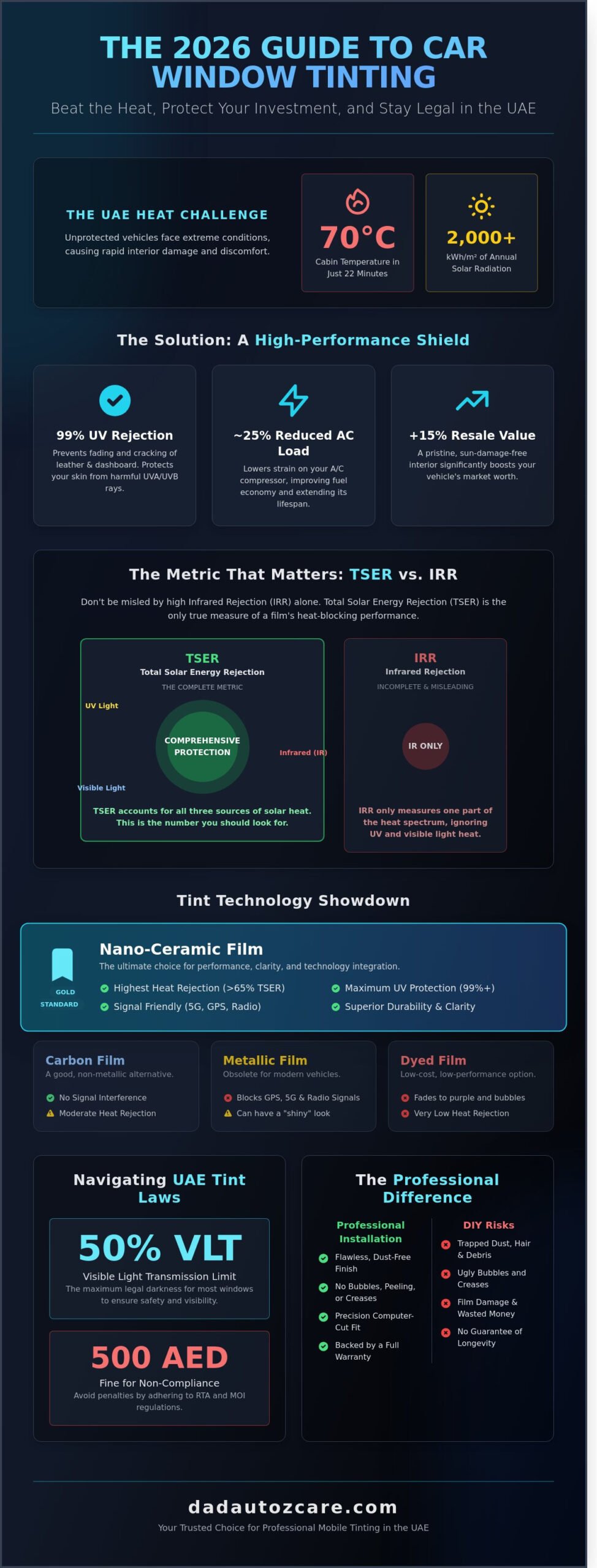
Did you know that an unprotected vehicle parked in Abu Dhabi can reach an internal temperature of 70°C in just 22 minutes? It’s a brutal reality that turns your premium leather interior into a kiln and puts immense strain on your AC system. Choosing the right car window tinting isn’t just about aesthetics; it’s a precision-engineered shield against the UAE’s relentless UV radiation. You’ve likely felt that searing heat when touching your steering wheel or worried about your dashboard cracking under the desert sun.
We believe your vehicle deserves better than generic solutions that bubble and peel after a single summer. This 2026 guide empowers you to master every technical, legal, and practical aspect of glass protection to ensure your cabin remains a cool sanctuary. You’ll learn how to comply with RTA and MOI regulations with confidence, avoiding 500 AED fines while achieving a 99% UV rejection rate. We are breaking down the latest nano-ceramic technologies and durability standards to help you secure a professional finish that preserves your car’s value for years, not just months.
Key Takeaways
- Understand why TSER (Total Solar Energy Rejection) is the essential metric for surviving the UAE’s extreme solar radiation, beyond just the darkness of the film.
- Discover why advanced nano-ceramic car window tinting is the superior choice for modern vehicles to ensure uninterrupted 5G, GPS, and radio connectivity.
- Navigate the legal requirements of Dubai and Abu Dhabi with a clear breakdown of the 50% VLT (Visible Light Transmission) regulations and enforcement.
- Learn how to select the ideal tinting package by matching premium film specifications to your specific vehicle type and daily driving habits.
- Identify the critical advantages of professional mobile installation to achieve a precision, dust-free finish at your home or office without the risks of DIY attempts.
The Science of Heat Rejection: Why Car Window Tinting is Vital in the UAE
In Dubai, the sun delivers over 2,000 kWh of solar radiation per square meter annually. This isn’t just a weather statistic; it’s a direct threat to your vehicle’s cabin and your physical health. Standard automotive glass allows nearly 90% of infrared heat and 70% of UV rays to penetrate the interior. High-performance car window tinting acts as a precision-engineered barrier, rejecting up to 99% of harmful UV rays. This protection prevents the greenhouse effect that can see cabin temperatures soar to 70°C in under 20 minutes when parked at Kite Beach or Dubai Mall.
Beyond comfort, professional tinting provides a significant mechanical advantage. By blocking solar energy, you reduce the thermal load on your air conditioning compressor by approximately 25%. This efficiency gain doesn’t just keep you cooler; it directly improves fuel economy and extends the lifespan of your HVAC system. For drivers spending 40 minutes or more in daily commutes, the reduction in direct skin exposure to UVA and UVB rays is a critical health precaution against long-term sun damage.
TSER vs. IRR: The Metrics That Matter
Many providers market 99% Infrared Rejection (IRR) as the ultimate performance metric, but this is misleading. IRR only measures a narrow band of the solar spectrum. To understand true performance, you must look at Window Film Technologies that prioritize Total Solar Energy Rejection (TSER). TSER is the only comprehensive measure of a film’s heat-rejecting performance, accounting for visible light, infrared, and ultraviolet energy. High-end ceramic films manage solar energy by reflecting it away from the glass or absorbing it and dissipating it outward, rather than letting it radiate into the cabin.
Protecting Your Investment: Interior Longevity
UV radiation is the primary cause of photodegradation in automotive materials. It breaks down the molecular bonds in leather, Alcantara, and dashboard polymers, leading to brittle surfaces and unsightly discoloration. A vehicle with a meticulously preserved interior can command a 15% higher resale value in the UAE secondary market compared to one with sun-damaged upholstery. To achieve total protection, we recommend pairing high-grade car window tinting with professional car polishing in Dubai to ensure the exterior reflects the same level of care as the pristine cabin. This holistic approach to detailing is the only way to maintain a showroom finish in our harsh desert climate.
Comparing Tint Technologies: Ceramic, Carbon, and Nano-Tech Films
The history of car window tinting has moved rapidly from simple dyed plastics to the precision-engineered films we use at Dad Auto Care. Early films focused only on privacy, but they failed miserably under the intense 45°C Dubai sun. Standard metallic films, once the industry go-to, are now obsolete. They disrupt GPS signals and 5G connectivity, making them a poor choice for modern, tech-heavy vehicles. Today’s drivers require seamless integration with their vehicle’s electronics. High-quality films must meet the rigorous standards set by the International Window Film Association to ensure they provide genuine protection rather than just a dark aesthetic.
Cheap films in the UAE often turn purple or bubble within 12 months. This degradation happens because low-grade dyes break down under extreme UV exposure. Premium nano-tech films avoid this entirely through inorganic compounds. By 2026, performance benchmarks for top-tier films include a Total Solar Energy Rejection (TSER) of over 65% and 99% UV protection. These aren’t just marketing numbers; they represent the long-term preservation of your car’s interior leather and dashboard electronics.
Nano-Ceramic Films: The Gold Standard
Nano-ceramic technology uses non-conductive particles to block up to 95% of infrared light. This keeps the cabin significantly cooler without affecting mobile signals or keyless entry systems. Unlike older carbon films, ceramic offers superior night-time clarity. This visual precision is vital for safety when driving on the E11 after sunset. You can explore the Nanoz window tinting guide for a deep dive into how these specific products outperform traditional options in the local climate.
Carbon and Crystalline Options
Carbon films remain a favorite for owners seeking a specific matte aesthetic. They don’t fade like dyed films and provide a distinct, non-reflective finish that many luxury car owners prefer. If you want heat protection without the dark look, crystalline films are the answer. They stay nearly transparent while blocking more heat than many dark, lower-quality films. Finding the right balance between cost and performance is easy when you consult with our detailing experts about your specific daily commute and parking conditions. We help you find the sweet spot where your budget meets 2026-grade protection.
The 2026 Car Tint Selection Matrix: Choosing the Right Package
Selecting the perfect film for your vehicle in Dubai isn’t just about picking a shade of black. It’s a technical decision where glass surface area meets thermal physics. An SUV like a Nissan Patrol features nearly 4.5 square meters of glass, acting as a massive heat sink in the 52°C Arabian summer. For these larger vehicles, high-performance car window tinting with maximum Infrared Rejection (IRR) is mandatory to prevent the AC system from redlining. Conversely, a sports coupe requires signal-enabling ceramic films that won’t interfere with GPS or 5G frequencies while maintaining a sleek, factory-fresh aesthetic.
The UAE market often confuses darkness with protection. In 2026, the ‘Privacy vs. Performance’ trade-off is a myth. A premium 70% VLT (Visible Light Transmission) nano-ceramic film can block more heat than a 5% “limo tint” made of cheap dyed polyester. We focus on the legal 50% limit, ensuring you stay compliant with Dubai Police regulations while enjoying a cabin that stays up to 12°C cooler. When we discuss ‘Lifetime Warranties,’ we mean protection against the desert’s specific threats: adhesive failure, bubbling, and the dreaded ‘purple-ing’ caused by UV chemical breakdown.
Tailored Packages for Dubai Drivers
- The Family Shield: This package prioritizes the safety of rear-seat passengers. It utilizes multi-layer ceramic technology to achieve 99% UV rejection, specifically designed to protect children’s sensitive skin from sun damage during long school runs.
- The Executive Stealth: Optimized for professionals, this setup hits the legal 50% VLT limit perfectly. It offers a sophisticated charcoal finish with 95% IRR, ensuring you arrive at meetings composed and cool.
- The Clear Heat Shield: A specialized solution for front windshields. It remains nearly invisible to the eye but blocks a massive amount of solar energy, protecting your dashboard from cracking and your hands from a burning steering wheel.
Budget vs. Premium: The Real Cost of Ownership
The math is simple. A budget tint job costing 400 AED might look acceptable for six months. However, the intense Dubai sun causes cheap dyes to fade and adhesives to fail rapidly. You’ll likely spend another 200 AED on removal fees and 400 AED on a replacement within two years. Investing in a premium 1,500 AED to 2,500 AED ceramic application pays for itself through increased fuel efficiency, as your AC compressor works 25% less hard. For a detailed breakdown of what you should expect to pay, visit our car tinting price UAE guide. High-quality car window tinting is a one-time investment that preserves your interior’s leather and electronics for the life of the vehicle.
Navigating UAE Tint Laws: Legal Limits in Dubai and Abu Dhabi
In 2017, the UAE Ministry of Interior revised Federal Traffic Law standards to allow a maximum of 50% Visible Light Transmission (VLT) for private vehicles. This regulation applies to the side and rear windows, providing a balance between driver privacy and road safety. While the law is federal, enforcement nuances exist. Dubai RTA inspectors typically focus on compliance during the annual registration renewal, while Abu Dhabi Police are known for rigorous roadside checks using calibrated VLT meters. If your car window tinting exceeds these limits, you risk a 1,500 AED fine and a potential 30-day vehicle impoundment.
- Individual Owners: Allowed up to 50% VLT on side and rear windows.
- Front Windshield: Must remain clear, though clear heat-rejection films are often permitted.
- Company Vehicles: Generally restricted to lower percentages or require specific permits depending on the trade license.
Exceptions to these rules are rare but possible. For instance, individuals with specific skin conditions or medical sensitivities can apply for a “Tinting Permit” through the RTA or relevant police department. This requires a certified medical report from a government hospital. Without this official permit, any film darker than the legal limit will result in an immediate inspection failure, forcing you to strip the film and pay for a re-test.
RTA and MOI Compliance Standards
Precision is vital during the annual vehicle inspection. RTA testing centers use digital light meters to ensure your film hasn’t “cured” darker or that the glass’s natural tint hasn’t pushed the total VLT over the limit. Many car owners don’t realize that factory glass often has a 70% VLT rating; adding a 50% film on top can technically result in an illegal 35% total transmission. We use professional-grade meters to verify your setup stays within the 1,500 AED fine threshold before you head to the testing center.
Safety and Night Visibility
Safety is the primary reason for these strict limits. While a 5% “limo tint” might look sleek, it’s incredibly dangerous on unlit desert highways or during evening sandstorms. It reduces your ability to spot hazards and pedestrians. Optical clarity is where premium films shine. A legal 50% ceramic tint can outperform illegal 100% dyed tint in heat rejection. By choosing high-quality ceramic materials, you get the thermal protection you need without sacrificing the clarity required for safe night driving.
Don’t risk fines or failed inspections; book our legal car window tinting for guaranteed compliance and maximum heat rejection.
Professional Mobile Tinting: Why Dad Auto Care is the UAE’s Trusted Choice
Choosing the right partner for your vehicle’s care isn’t just about price; it’s about the precision of the craft. At Dad Auto Care, we’ve redefined the standard for car window tinting across the Emirates. We understand that your time is the ultimate luxury. That’s why our 24/7 mobile units bring the workshop directly to your driveway or office parking. You don’t have to navigate Dubai traffic or lose a workday to get premium protection.
Many DIY kits or low-end shops fail because they can’t control the environment. A single stray hair or a speck of desert dust trapped under the film ruins the aesthetic and the bond. We’ve mastered the art of creating a controlled, “clean room” micro-environment at your location. Our technicians use specialized shielding and high-pressure filtration tools to ensure a factory-grade finish every time. This meticulous approach is why we’re the trusted choice for owners who refuse to compromise on quality.
The Mobile Installation Advantage
Efficiency meets excellence in our mobile service. By choosing us, you’re saving at least 4 hours of your day. There’s no waiting in a cramped lounge or arranging a ride home. Whether you’re in the heart of Dubai, the residential districts of Abu Dhabi, or the bustling streets of Sharjah, we arrive fully equipped. Our process ensures that your vehicle remains pristine. We treat every car with a “detailing” mindset, focusing on those microscopic edges where others often cut corners.
Total Vehicle Protection Solutions
We believe in holistic care. While car window tinting blocks heat, it’s even more effective when paired with ceramic coating for cars in Abu Dhabi. This combination creates a 360-degree shield against the UAE’s harsh UV rays and abrasive sand. Our 2026 range of heat-rejection films offers up to 99% infrared rejection, keeping your cabin cool even when the external temperature hits 50°C.
- Premium films for cars, luxury yachts, and residential villas.
- Expert polishing services to restore paint depth before coating.
- A comprehensive guarantee on both materials and craftsmanship.
Don’t let the sun devalue your investment. Experience the Dad Auto Care difference where passion meets technical mastery. Book your mobile window tinting service today and give your vehicle the elite treatment it deserves.
Master the UAE Heat with Precision Tinting
Choosing the right car window tinting isn’t just about aesthetics; it’s a vital investment in your vehicle’s longevity and your personal comfort. Premium ceramic nano-technology now rejects up to 99% of infrared heat, keeping your cabin significantly cooler even when summer temperatures hit 50°C. Staying within the 50% transparency limit ensures your car remains RTA-compliant while providing the privacy and UV protection you deserve. At Dad Auto Care, we treat every installation as a piece of precision art, ensuring a bubble-free finish that preserves your car’s value for years to come.
We’ve streamlined the process with our 24/7 mobile service, bringing world-class detailing expertise directly to your driveway in Dubai or Abu Dhabi. You don’t have to settle for basic films that bubble or fade after one season. Our 2026 selection focuses on durability and high-definition clarity for the road ahead. Your vehicle represents a significant investment, and it deserves the highest level of care available in the Emirates today.
Protect your car from the heat-Get a Professional Tint Quote Now
We look forward to restoring that showroom feel to your car while providing the ultimate shield against the desert sun.
Frequently Asked Questions
What is the legal car window tint percentage in Dubai for 2026?
The legal limit for car window tinting in Dubai is currently 50% for side and rear windows according to RTA regulations. This percentage applies to private light vehicles, while commercial vehicles and taxis face different restrictions. You aren’t allowed to tint the front windshield, though clear heat-rejection films are often permitted for safety. Our team ensures every installation meets these specific legal standards to help you avoid fines starting from 1,500 AED.
How long does it take to tint a car with Dad Auto Care’s mobile service?
A professional car window tinting session typically takes between 90 and 150 minutes to complete at your location. We arrive with all the necessary precision tools to ensure a factory-quality finish in your own driveway or office parking. Larger SUVs might require an additional 30 minutes for meticulous glass preparation. This efficient mobile service saves you at least three hours of travel and waiting time at a traditional workshop.
Can I wash my car windows immediately after tinting?
You shouldn’t wash or roll down your windows for at least 72 hours after the application. This crucial period allows the adhesive to cure and the remaining moisture to evaporate completely from between the film and the glass. Rolling the windows down too early can cause the film to peel or shift at the edges. After the third day, use a soft microfiber cloth and ammonia-free cleaners to keep the glass immaculate.
Does car window tinting interfere with mobile phone or GPS signals?
High-quality ceramic films don’t interfere with your mobile phone, GPS, or radio signals. Older metallic tints often blocked electronic waves, but our modern 100% metal-free ceramic films ensure seamless 5G connectivity. You’ll enjoy maximum heat rejection without losing any bars on your navigation system or smartphone. We prioritize both your driving comfort and your vehicle’s technological integrity by using only advanced, signal-friendly materials.
What is the difference between ceramic and regular window tint?
Ceramic tint offers up to 95% infrared heat rejection, while regular dyed films primarily provide shade and privacy. Regular tints are prone to fading or turning purple after just 12 months in the intense Dubai sun. Ceramic technology uses nano-ceramic particles that are non-conductive and far more durable. It’s a premium investment that maintains its deep color for years while protecting your car’s interior from 99% of harmful UV rays.
How much does professional car window tinting cost in the UAE?
Professional car window tinting in the UAE typically ranges from 800 AED to 3,000 AED depending on the vehicle size and film quality. A standard sedan package with premium ceramic film usually costs around 1,500 AED. While budget options exist for 400 AED, they often lack the heat rejection properties needed for 50°C summers. Investing in a higher-grade film ensures better durability and significant long-term value preservation for your vehicle.
Will window tinting help reduce my car’s fuel consumption?
Yes, professional window tinting can reduce your fuel consumption by 7% to 12% during the peak summer months. By blocking a massive amount of solar heat, your air conditioning system doesn’t have to work as hard to maintain a cool cabin. This lower load on the engine directly translates to better petrol mileage. It’s a practical way to improve efficiency while protecting your engine from the strain of constant maximum cooling.
Is there a warranty on the window films used by Dad Auto Care?
We provide a comprehensive 5-year warranty on all our premium window film installations. This guarantee covers you against common issues such as bubbling, peeling, or manufacturer defects. Our commitment to precision means we only use world-class materials designed to withstand the harsh Middle Eastern climate. If any part of the film fails within this period, we’ll replace it at no extra cost to ensure your vehicle remains in an immaculate state.