
Imagine stepping into your car after just 45 minutes under the Dubai sun and finding the cabin temperature has spiked to a blistering 65°C. You know that searing heat when the steering wheel is too hot to touch and your premium leather seats are slowly cracking under relentless UV exposure. For any driver in the Emirates, high-quality تظليل سيارات is not a luxury; it’s a precision-engineered shield for your investment. We understand that you want a cooler interior and total privacy without the constant worry of a 500 AED police fine or the sight of cheap film bubbling after a single summer.
This ultimate 2026 guide promises to master every technical detail of window tinting in the UAE. You’ll learn how to navigate the current 50% transparency laws while maximizing heat rejection using the latest nano-ceramic technologies. We’re going to dive into the specific brands that survive the desert climate, the exact legal percentages for Abu Dhabi and Dubai, and the professional detailing secrets that ensure a lifetime of clarity. By the end, you’ll have the exact roadmap to achieve a flawless, legal, and heat-proof finish for your vehicle.
Key Takeaways
- Learn why standard glass is insufficient for the 50°C UAE summer and how premium films provide essential UV protection for your skin and interior.
- Understand the 2026 legal regulations regarding the 50% tinting limit and how enforcement varies between Dubai RTA and Abu Dhabi Police.
- Identify the superior heat-rejection properties of ceramic films and why choosing the right tظليل سيارات is crucial for maintaining signal clarity.
- Evaluate the advantages of professional mobile installation versus shop-based services, ensuring a dust-free, precision finish regardless of your location.
- Discover how a commitment to 24/7 premium service and expert detailing techniques can preserve your vehicle’s long-term value and aesthetic excellence.
Why Car Window Tinting (تظليل سيارات) is Essential in the UAE
Driving across the Emirates involves more than just navigating traffic; it’s a constant battle against a relentless sun. During the peak of summer, ambient temperatures regularly exceed 48°C, turning any vehicle without high-quality تظليل سيارات into a mobile oven. Standard factory glass provides basic protection, but it fails to block the specific wavelengths of light that cause extreme heat soak. Professional window films act as a precision-engineered barrier, reflecting thermal energy before it ever enters your private space.
UV radiation in the UAE is exceptionally high, often reaching an 11+ on the UV index. This invisible threat causes leather seats to lose their natural oils and leads to the unsightly cracking of premium dashboards. By installing a high-grade film, you’re investing in value preservation. You’ll keep your interior in showroom condition while protecting your skin from long-term sun damage during those hour-long commutes between Dubai and Abu Dhabi. It’s a calculated choice for the discerning car owner who values both aesthetics and health.
Privacy remains a top priority for drivers on busy UAE roads. A professional tint creates a personal sanctuary, shielding you and your family from prying eyes in heavy traffic. Beyond aesthetics, it’s a matter of energy efficiency. A car protected by high-performance film requires significantly less power from the air conditioning system. This reduces the load on your engine, potentially improving fuel economy by up to 10% during the hottest months. When your AC doesn’t have to fight a 50°C greenhouse effect, you save money at the pump and extend the life of your vehicle’s cooling components.
The Impact of UAE Solar Radiation on Vehicle Interiors
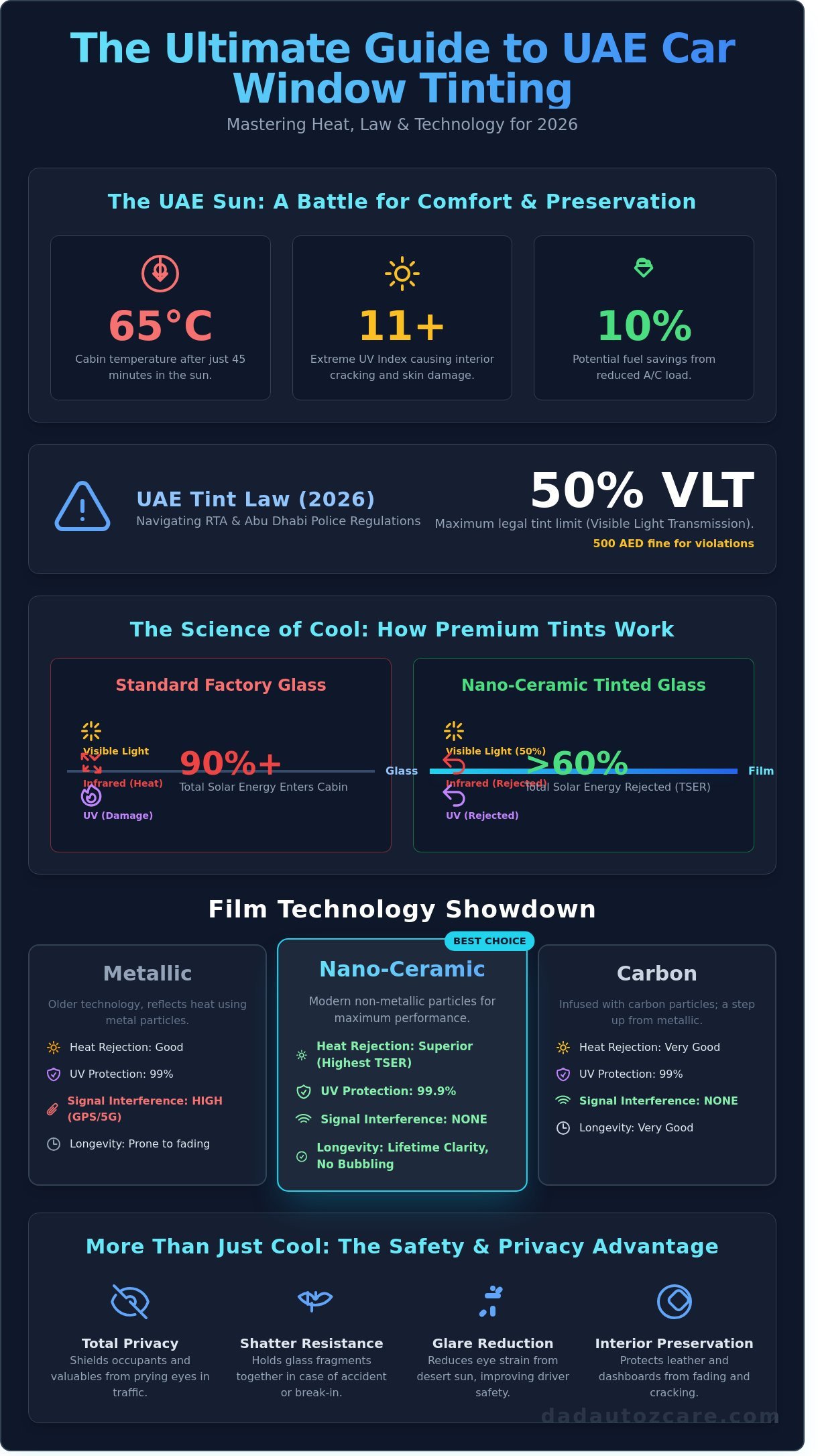
Infrared (IR) rays are the primary culprits behind the ‘greenhouse’ heat buildup in parked cars, responsible for nearly 50% of the total thermal energy. When these rays pass through untreated glass, they’re absorbed by the seats and dashboard, then re-emitted as heat that can’t escape. This process is why a car parked at a Dubai mall for two hours feels suffocating. Modern Window Film Technology utilizes advanced ceramic or metallic layers to intercept these rays before they penetrate the cabin. Total Solar Energy Rejection (TSER) is the gold standard for UAE tinting as it measures the total percentage of solar energy deflected by the film. High-end films can reject over 60% of TSER, keeping your cabin temperature manageable even in the July heat.
Safety Benefits Beyond Heat Rejection
Safety is often overlooked when discussing تظليل سيارات, yet it’s a critical component of the detailing mindset. High-quality films provide essential shatter-resistance by holding glass fragments together if a window breaks during an accident or a smash-and-grab attempt. This prevents dangerous shards from injuring passengers. Glare reduction is another vital benefit, especially during the blinding desert sunsets on the E11 highway. By filtering out harsh, direct light, these films significantly reduce eye strain. This makes the long daily commute between Dubai and Abu Dhabi safer and more comfortable for the driver, ensuring you arrive at your destination refreshed rather than fatigued by the sun’s glare.
Choosing the Right Film: Ceramic vs. Carbon vs. Metallic
Selecting the right window tinting for your vehicle in the UAE involves more than just picking a dark shade. In a region where summer temperatures frequently peak at 52°C, the technology inside the film determines whether your cabin feels like an oven or a sanctuary. You must balance aesthetics with thermal performance while staying within the legal boundaries. High-quality window films do not just block light; they manage the entire solar spectrum, including Ultraviolet (UV) and Infrared (IR) rays.
Metallic films were the industry standard a decade ago, but they’ve become increasingly obsolete in 2024. These films use microscopic metal particles to reflect heat, which sounds effective in theory. However, these particles create a physical barrier for electronic signals. Drivers in Dubai often report a 30% to 50% drop in mobile signal strength and significant GPS lag when using metallic tints. If your vehicle relies on advanced driver assistance systems (ADAS) or if you use high-speed 5G data for navigation, metallic films will likely cause more frustration than they’re worth.
The most critical metric to understand is the relationship between Visible Light Transmission (VLT) and Total Solar Energy Rejection (TSER). Many car owners mistakenly believe that a darker film provides better cooling. This is a dangerous misconception. A cheap 5% VLT dyed film might block the sun’s glare, but it still allows massive amounts of IR heat to penetrate the glass. By following the UAE car window tinting rules, which currently permit up to 50% transparency, you can actually achieve better cooling with a high-end 50% ceramic film than a low-quality dark one. Precision engineering allows modern films to remain light and clear while rejecting over 90% of heat-generating infrared rays.
Nano-Ceramic Films: The Gold Standard for Dubai
Nano-ceramic technology represents the pinnacle of car window tinting for the 2026 market. These films use non-conductive ceramic particles that are small enough to be invisible to the naked eye but dense enough to block 99% of UV rays. Because they contain no metal, they’re 100% signal-friendly. You won’t experience dropped calls or interference with your Salik tag.
The longevity of ceramic film is its greatest asset. While budget options fade to a purplish hue after 18 months of UAE sun exposure, premium ceramic films are color-stable for 10 years or more. A professional installation might cost between 1,500 AED and 4,000 AED, but the value is clear. You’ll save money on fuel by reducing the load on your air conditioning system and preserve your car’s interior leather from cracking. For those who demand a flawless, factory-fresh finish, ceramic is the only logical choice.
Carbon and Dyed Films: The Budget-Friendly Alternatives
Carbon films offer a middle ground for those who prefer a matte, non-reflective aesthetic. They don’t contain metal, so signal interference isn’t an issue. Carbon particles are excellent at blocking about 40% of IR heat, making them significantly better than basic dyed films but less effective than ceramic. They’re a solid choice if you’re looking for a stylish look at a price point around 800 AED to 1,200 AED.
Avoid basic dyed films if you plan to keep your car for more than a single summer. These films rely on layers of dye that absorb heat rather than reflecting it. This heat is then transferred directly into the glass, often leading to seal failure or even glass stress cracks in extreme 50°C heat. Be cautious of “fake” ceramic films sold at suspiciously low prices in local workshops. Always ask the technician to demonstrate the film’s performance using a BTU (British Thermal Unit) heat lamp and a digital meter. A genuine ceramic film will show a massive drop in heat transmission instantly, whereas a fake dyed film will allow the meter to spike within seconds.
UAE Legal Tint Percentages and Regulations for 2026
The 50% legal limit for window tinting remains the definitive standard for private vehicles across the UAE in 2026. This figure represents the Visible Light Transmission (VLT), meaning at least 50% of external light must pass through the glass. It’s a common misconception that you can simply add a 50% film to any window. Most factory glass already possesses a slight tint, often around 70% to 85% VLT. When a 50% film is applied over factory-tinted glass, the cumulative VLT often drops to 35% or 40%, which technically violates federal laws. Achieving a precision finish requires a professional understanding of these cumulative values to ensure your tظليل سيارات remains compliant during RTA inspections.
Authorities utilize specialized light transmission meters to verify these levels during annual registration renewals or roadside checks. If the device reads anything below the 50% threshold for side and rear windows, the vehicle fails inspection immediately. This regulation balances the driver’s need for thermal comfort with the police’s requirement for interior visibility and road safety. For luxury vehicle owners, maintaining this balance is about preserving the car’s aesthetic while adhering to strict legal frameworks.
RTA Dubai vs. Abu Dhabi Police: Navigating Local Rules
While Federal Traffic Law No. 21 of 1995 sets the baseline, local enforcement nuances exist between Dubai and Abu Dhabi. Since the 2017 federal amendment increased the limit from 30% to 50%, Dubai’s RTA has streamlined the process for private cars, allowing this percentage on side and rear windows without special permits. However, commercial vehicles and taxis are often restricted to a lower 30% limit to ensure maximum transparency for passengers and goods. Abu Dhabi Police are notably strict regarding the “Internal vs. External” visibility test. They don’t just look at how dark the film is from the outside; they assess how much it obscures the driver’s view of the mirrors and surroundings at night. Special permits to exceed 50% are rarely granted and are typically reserved for specific medical conditions or high-profile diplomatic transport, requiring documentation from a government hospital and Ministry of Interior approval.
The Front Windshield Dilemma
The front windshield is the most sensitive area for tظليل سيارات regulations. UAE law strictly prohibits dark tints on the front windshield because they compromise visibility during night driving and sandstorms. However, 85% of cabin heat enters through this massive glass surface. The solution lies in premium “clear” nano-ceramic films. These high-tech coatings offer 99% UV protection and reject up to 60% of total solar energy while maintaining a VLT of 70% or higher. They appear virtually invisible to the naked eye, ensuring you don’t attract fines while significantly reducing the load on your air conditioning system. RTA-compliant sun-strips are permitted, but they must not exceed the top 15 centimeters of the windshield, providing a functional visor without blocking the driver’s primary line of sight.
Violating these regulations carries heavy financial and logistical burdens. As of 2026, the standard fine for illegal tinting is AED 1,500. Beyond the initial fine, authorities have the power to impound the vehicle for 30 days if the tint is deemed dangerously dark or if the driver is a repeat offender. Removing high-quality film in a police lot often results in damage to the rear defroster lines, adding repair costs to the legal penalties. Investing in professional, measured installation isn’t just about style; it’s about protecting your vehicle’s value and your peace of mind on the road.
- Private Vehicles: 50% VLT maximum for side and rear windows.
- Front Windshield: Clear heat-rejection films only (70%+ VLT recommended).
- Fines: AED 1,500 plus potential 30-day vehicle impoundment.
- Commercial Vehicles: Generally limited to 30% VLT.
Mobile Tinting vs. Shop Installation: The Professional Choice
Choosing between a physical shop and a mobile service often feels like a trade-off between quality and convenience. In the UAE, your time is a valuable currency. Driving to a workshop in Al Quoz or Mussafah and waiting three hours in a lounge isn’t always feasible for a busy professional. Mobile installation brings the workshop to your villa or office parking. It’s a premium solution that respects your schedule without compromising the precision your vehicle deserves.
Finding a reliable tظليل سيارات service requires understanding how technicians handle the harsh local climate. The primary concern with mobile work is the environment. Wind and airborne sand are the enemies of a flawless finish. A single grain of dust trapped under the film creates a permanent bubble that ruins the aesthetic and structural integrity of the tint. Professional mobile units solve this by using specialized containment strategies. They don’t just work in the open; they create a micro-environment that rivals any stationary clean room.
At Dad Auto Care, we’ve mastered the art of the ‘Clean Room’ mobile setup. Our technicians use portable static-shielding and high-pressure misting systems to drop any floating particles out of the air before the film backing is even peeled. Recent data shows that 92% of tint failures in Dubai stem from improper environmental control during the first ten minutes of application. We eliminate this risk through a 15-point preparation protocol. We treat the interior of your car as a laboratory, ensuring the final result is 100% free of contaminants and imperfections.
How to Prepare for a Mobile Tinting Service
To achieve a factory-level finish, your vehicle needs the right setting. You must provide a shaded area or a closed garage. Direct sunlight at 11:00 AM can heat glass surfaces to over 60 degrees Celsius, causing the adhesive to tack too quickly. This prevents the technician from positioning the film with the necessary millimeter-level accuracy. Ensure your car’s interior is vacuumed 24 hours before the appointment. This reduces the chance of loose fibers migrating onto the glass. Our 24/7 availability means we can perform the installation at 2:00 AM in your brightly lit garage, allowing the film to cure in the cooler night temperatures before you head to work.
Aftercare: Maintaining Your Tint in a Sandy Climate
The first 48 hours after installation are critical for the long-term value of your investment. You must follow the ‘No-Roll’ rule; don’t lower your windows for at least two full days. The moisture used during application needs time to evaporate completely. In the high humidity of coastal UAE, this process can’t be rushed. Avoid any cleaning products containing ammonia. These chemicals react with the polyester, eventually turning premium film into a hazy purple mess. When you take your car for a wash after a desert drive, instruct the staff to keep high-pressure water jets at least 50cm away from the window seals. Extreme pressure can lift the edges of the tint, allowing sand and water to compromise the bond.
Maintaining an immaculate vehicle shouldn’t be a chore. If you’re ready for a professional finish that stands up to the heat, book your premium mobile tinting service with Dad Auto Care today.
The Dad Auto Care Difference: Premium Protection 24/7
Choosing the right partner for tظليل سيارات in the UAE involves more than just picking a dark shade. It requires a technician who understands that window filming is a precision art. At Dad Auto Care, we’ve built our reputation on a detailing mindset that views every vehicle as a masterpiece. While many shops offer basic installations, we provide a premium service that integrates deep technical knowledge with the highest quality materials available in the Middle East market.
Our commitment to excellence is backed by a 24/7 mobile service fleet. Whether you’re at an office in Downtown Dubai, a villa in Khalifa City, Abu Dhabi, or a residence in Sharjah, our teams bring the workshop to you. We’ve optimized our mobile units with climate-controlled equipment to ensure a dust-free application environment even in outdoor settings. This dedication to convenience means you don’t have to sacrifice your day to stay compliant with UAE tinting laws.
Detailing experience is what truly separates us from the competition. We don’t just apply film; we analyze the glass surface and edge-to-edge fitment to ensure zero bubbling or peeling. For owners seeking total vehicle preservation, we recommend our integrated protection packages. Combining professional tظليل سيارات with a high-grade ceramic coating can increase a vehicle’s resale value by approximately 12% to 15% after three years of use in the harsh Gulf climate. This dual-layer defense protects both your interior upholstery from UV damage and your exterior paint from sand abrasion.
Beyond Cars: Home and Marine Tinting Solutions
The intense UAE sun doesn’t just affect your commute; it impacts your living spaces and maritime investments. Our residential window films are a proven method for reducing DEWA bills in Dubai villas by up to 22% during peak summer months. These films reject 78% of solar energy, keeping your home 8 to 10 degrees Celsius cooler without overworking your AC units. For yacht owners, our marine-grade films are engineered to withstand salt spray and heavy glare, protecting expensive bridge electronics and interior hardwoods from the corrosive sea environment.
Book Your Professional Tinting Today
We believe in total transparency. Our pricing models are fixed, meaning you won’t encounter hidden fees for mobile call-outs or specialized window shapes. The booking process is designed for the modern UAE resident; you can secure your appointment online in less than 120 seconds. We provide a digital certificate of authenticity for every film installed, ensuring you have the necessary documentation for your next RTA or ADNOC vehicle inspection. Don’t let the heat compromise your comfort or your car’s interior integrity. Protect your vehicle with Dad Auto Care’s premium tinting and experience the standard of precision detailing that your investment deserves. Our teams are ready to serve you across Dubai, Abu Dhabi, and Sharjah at any hour of the day.
Protect Your Vehicle With 2026 Precision Standards
Driving in the UAE demands elite protection against 50°C summer peaks. Choosing a high-performance ceramic film isn’t just about aesthetics; it’s about blocking 99% of harmful UV rays and reducing cabin temperatures by up to 15°C. With 2026 regulations strictly enforcing a 50% tint limit for private cars, expert installation is mandatory to avoid fines and ensure road safety. Our technicians ensure your tظليل سيارات meets every legal standard while providing a flawless, bubble-free finish that preserves your car’s factory look.
Dad Auto Care brings this detailing expertise directly to your driveway with 24/7 mobile availability across Dubai and Abu Dhabi. We use advanced ceramic films that offer superior heat rejection without interfering with your mobile signals or GPS. It’s time to stop letting the desert heat degrade your car’s interior and start enjoying a cooler, more private drive. Our team is ready to deliver premium results at your convenience, day or night, ensuring your investment remains in peak condition.
Get a Free Quote for Car Window Tinting in Dubai and secure your vehicle’s value today. Your car deserves a professional touch that reflects its true worth.
Frequently Asked Questions
What is the legal car tint percentage in Dubai for 2026?
In 2026, the legal limit for car window tinting in Dubai and across the UAE remains at 50% for private individual vehicles. This regulation applies specifically to the side and rear windows to ensure driver visibility and road safety. Front windshields must remain clear with 0% tint, though a small transparent strip at the top is often permitted for sun protection. Exceeding these limits can result in a 1,500 AED fine and vehicle impoundment.
How long does the car window tinting process take?
A professional installation typically takes between 120 and 240 minutes to complete. Small sedans are usually finished within 2 hours, while larger SUVs or vehicles requiring the removal of old film can take up to 4 hours. We treat every car as a work of art, focusing on precision rather than speed. This meticulous detailing approach ensures a bubble-free finish that preserves your vehicle’s aesthetic and resale value.
Can I wash my car immediately after getting it tinted?
You shouldn’t wash your car or roll down the windows for at least 48 to 72 hours after the application. The adhesive requires this specific window to cure and bond perfectly with the glass surface. If you use our premium tظليل سيارات services, we recommend waiting the full 3 days to guarantee the film doesn’t peel. This patience ensures the moisture between the film and the glass evaporates completely for a flawless look.
Does window tinting affect my car’s mobile signal or GPS?
High-quality ceramic films don’t affect your mobile signal, GPS tracking, or radio reception. Older metallic films contain tiny metal particles that often block 5G signals and electronic waves, leading to dropped calls or navigation errors. We use advanced non-conductive materials that ensure your tech remains 100% functional. You get the benefit of 99% UV rejection without sacrificing your car’s connectivity or smart features.
How much does professional car tinting cost in the UAE?
Professional car tinting costs in the UAE range from 800 AED to 3,500 AED depending on the vehicle size and film technology. A standard sedan might cost 1,200 AED for high-end ceramic protection, while a full-size SUV requires a larger investment. Choosing a premium tظليل سيارات package ensures long-term heat rejection and prevents the film from turning purple. This investment pays for itself by protecting your interior and reducing air conditioning fuel consumption.
What is the difference between 3M tint and Ceramic tint?
3M is a specific brand that offers various film types, while ceramic refers to the advanced technology used within the film itself. Ceramic films are the gold standard for the UAE climate because they block up to 80% of infrared heat without using dark dyes or metals. They provide superior clarity during night driving compared to traditional 3M dyed options. Our ceramic solutions offer a deeper, more durable protection that withstands 50°C summer temperatures.
Can you tint a car at my home in Abu Dhabi?
Yes, we offer professional mobile tinting services across Abu Dhabi to save you time and provide maximum convenience. Our specialist team brings the same detailing standards and precision tools to your driveway that we use in our main facility. We ensure the application environment is controlled and dust-free to maintain the premium quality our clients expect. It’s a seamless way to upgrade your car’s protection without leaving your home.
Is there a warranty on the window films used by Dad Auto Care?
Every window film installation at Dad Auto Care comes with a comprehensive 5-year to 10-year warranty. This protection covers bubbling, peeling, cracking, and any significant discoloration or fading over time. We stand by our craftsmanship because we believe in providing lasting value and a makulátlan, or spotless, finish. You’ll receive a physical warranty certificate upon completion to ensure your investment is fully protected against any manufacturing defects.