
Did you know that on a typical 45°C summer day in Dubai, your car’s interior can soar to over 80°C? It’s a familiar, frustrating reality: searing steering wheels, an AC working overtime, and the constant worry about UV damage to your skin and premium leather. Choosing the right car tint isn’t just a cosmetic upgrade; it’s an essential defense against the extreme UAE climate.
We understand that navigating the options and legal rules can be confusing. This comprehensive 2026 encyclopedia is your definitive resource for mastering the science, technology, and crucial legalities of window tinting in Dubai and Abu Dhabi. We promise you’ll walk away with the precise knowledge needed to protect your vehicle, enhance your comfort, and ensure every Dirham spent is a smart investment in your driving experience.
Get ready to decode everything from the heat rejection power of advanced ceramic films to the exact RTA tinting laws you must follow, guaranteeing a flawless, bubble-free finish that elevates and protects your car for years to come.
Key Takeaways
- Learn why the extreme UAE climate demands more than just dark windows and understand the science behind true heat rejection in 50°C+ temperatures.
- Go beyond visible darkness (VLT) and identify the single most important technical specification-TSER-to accurately measure a film’s cooling performance.
- Compare modern ceramic vs. older films to choose the right car tint that provides maximum heat blocking without interfering with your vehicle’s GPS or phone signals.
- Discover the crucial post-installation rules, from the 48-hour curing period to the correct cleaning agents, to ensure your investment lasts for years.
The Invisible Shield: Why Car Tint is Vital in the UAE Climate
In a region where summer temperatures consistently soar above 50°C, your vehicle is more than just transport; it’s a sanctuary from the relentless sun. But standard glass offers minimal protection. This is where a professional car tint transcends aesthetics to become an essential component of vehicle ownership in the UAE. It’s not simply a darkened film. It’s a precision-engineered, multi-layered polyester shield designed with advanced thermal rejection properties to combat the extreme climate of Abu Dhabi and Dubai.
Beyond creating a sleek, uniform look, this invisible shield delivers a tangible economic impact. By significantly reducing the heat penetrating your car’s cabin, the film lessens the burden on your air conditioning system. A less stressed AC unit consumes less energy, which translates directly into improved fuel efficiency for petrol vehicles and, critically, an extended range for electric vehicles (EVs). This efficiency gain means fewer trips to the pump and less time tethered to a charging station, saving you both time and money in the long run.
Thermal Comfort and Health Protection
Your daily commute along Sheikh Zayed Road or the Corniche exposes you to intense solar radiation. Premium window films are engineered to block up to 99% of harmful ultraviolet (UV) rays, the primary cause of skin aging and potential skin cancers. This level of protection is vital for you and your family. The immediate benefit you’ll feel is a drastically cooler interior, with some high-performance films reducing cabin temperatures by as much as 15°C. This protection extends to your vehicle’s interior, safeguarding premium leather, Alcantara, and dashboard composites from the cracking and “sun-bleaching” that degrades both appearance and value.
Safety and Privacy on UAE Roads
Driving in the Emirates presents unique challenges, from the blinding glare of the midday sun to the intense high-beam headlights common on highways at night. A quality tint significantly cuts down this glare, reducing eye strain and allowing you to focus completely on the road ahead. It also provides a crucial layer of privacy for families and high-profile individuals navigating busy city traffic. Perhaps its most underrated feature is safety during an impact. The film’s strong adhesive holds shattered glass together, preventing dangerous shards from flying into the cabin. This “shatter-proof” effect is a foundational benefit of modern Window film technology, transforming a standard window into a laminated safety barrier. Of course, while film can help contain damage, it’s no substitute for repairing a compromised windscreen. If your glass already has chips or cracks, it’s vital to address them promptly to maintain structural safety; you can learn more about when and how to handle such repairs.
Decoding Tint Specs: Understanding TSER, IRR, and UV Protection
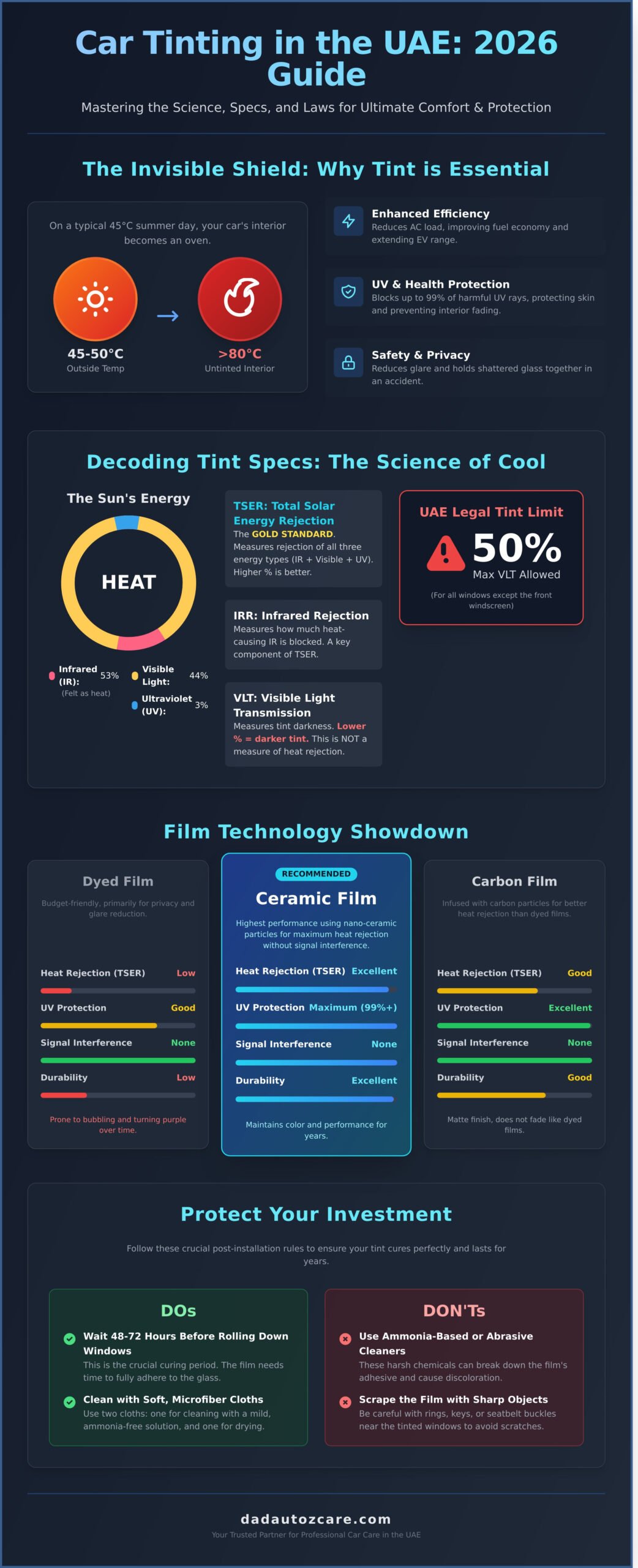
Choosing the right car tint in Abu Dhabi isn’t just about picking the darkest shade. A common misconception is that a darker film automatically provides more heat rejection. This is simply not true. True performance lies in the science of the film itself, and understanding a few key metrics will empower you to make a decision that delivers genuine comfort and protection. The sun’s energy is composed of three things: Ultraviolet (UV) light, Visible Light, and Infrared (IR) light. While UV rays are the primary cause of interior fading and skin damage, as confirmed by the extensive research on the UV protection benefits of window tint, it’s the combination of all three that creates heat inside your car.
To measure a film’s true effectiveness, you need one gold standard metric. Total Solar Energy Rejection (TSER) is the only metric that accounts for all three types of solar energy. It provides a complete and honest picture of how much heat a window film will actually block.
Visible Light Transmission (VLT) Explained
VLT measures how much visible light passes through your windows. A lower percentage means a darker tint; for example, a 30% VLT film allows 30% of light to enter, making it darker than a 50% VLT film. In the UAE, there are strict regulations to ensure road safety. The legal limit is 50% VLT for all windows, excluding the front windscreen. Choosing a film darker than this can result in fines and compromises your visibility, especially during night driving in poorly lit areas.
The Science of Heat Rejection
That intense, burning sensation you feel on your skin from the Abu Dhabi sun? That’s primarily from Infrared (IR) rays, which are invisible and account for approximately 53% of the sun’s heat. High-performance films are engineered with advanced particles, like ceramic nano-particles, that are designed to reflect this specific type of energy. Unlike older metallic films that could interfere with GPS and phone signals, the 2026-grade technology focuses on “Spectrally Selective” films. These marvels of engineering target and block the heat-producing IR and UV wavelengths with incredible precision, without having to be dark.
This is where many consumers are misled. A brand might advertise an impressive 97% IRR (Infrared Rejection), but this number is incomplete. Since IR is only about half the story, a film could have a high IRR but a low TSER if it fails to block heat generated by visible light. Don’t be fooled by a single, flashy number. Always ask for the TSER value; it’s the true measure of performance and the only figure that guarantees a cooler cabin.
Choosing the right film involves balancing legal compliance with VLT, your aesthetic preference, and pure heat-blocking performance. Understanding these specifications is the first step toward making a wise investment. A professional consultation on premium car tint options can demystify this process, ensuring the film you choose delivers the precise protection and comfort you expect for your vehicle.
Comparing Film Technologies: Ceramic vs. Carbon vs. Dyed Tints
Choosing the right car tint isn’t just about picking a shade; it’s about selecting a technology engineered to perform. The industry has evolved dramatically from basic dyed sheets to sophisticated, aerospace-grade films. Early metallic tints, for example, were effective at reflecting heat but came with a major drawback in our connected world: they block GPS, mobile phone, and radio signals. In a city like Abu Dhabi, that’s simply not an option. Understanding the difference between modern films is crucial to finding the sweet spot between your budget and the performance your vehicle truly needs.
Dyed and Carbon Films: The Entry Level
Dyed window tint is the most basic and affordable option, often available for as little as 250 د.إ to 400 د.إ. It consists of a layer of dye sandwiched between an adhesive layer and a protective top coat. While it provides privacy and reduces some glare, its heat rejection is minimal, often blocking less than 30% of total solar energy. Its biggest weakness in the UAE is durability; the intense sun exposure causes the dye to break down, leading to a hazy purple discoloration and fading within 18 months.
Carbon film is a significant upgrade. It contains microscopic carbon particles that are infused into the film. These particles are incredibly stable and will never fade. Carbon tint offers better heat rejection than dyed films (typically 40-50%) and provides a true black, matte finish that many drivers prefer. It’s a solid, reliable choice for a mid-range budget, usually costing between 600 د.إ and 900 د.إ, offering a great balance of performance and value.
Ceramic and Nano-Ceramic: The Premium Standard
This is the pinnacle of window tint technology. Ceramic films contain non-conductive, non-metallic ceramic nano-particles. These particles are masterful at targeting and blocking infrared (IR) light, the specific wavelength that produces heat, without needing to be dark. A high-quality ceramic tint can block over 85% of infrared heat, even in a lighter shade that’s fully compliant with UAE traffic laws.
The result is superior clarity. Looking through a ceramic-tinted window feels almost like looking through clear, factory glass, but without the oppressive heat and glare. This technology also excels in durability. The bubbling and peeling you see on cars across Abu Dhabi is a result of low-quality adhesives failing under extreme heat. Our premium ceramic films use advanced adhesives engineered to withstand temperatures exceeding 60°C, ensuring a flawless, bubble-free finish for years.
So, which should you choose? For the extreme climate of the UAE, where the UV index frequently hits 11+, we at Dad Auto Care professionally recommend ceramic tint. While carbon film is a capable product, ceramic film is an investment in superior comfort, safety, and vehicle preservation. The International Window Film Association confirms that advanced window films can block over 99% of damaging UV-A and UV-B rays, a benchmark that premium ceramic films meet effortlessly. This isn’t just about keeping your car cool; it’s about protecting your skin and your car’s interior from irreversible sun damage.
Maximizing Longevity: Essential Maintenance for Your Car Tint
Investing in a professional car tint application is the first step toward superior comfort and protection. However, to ensure your investment lasts for years under the relentless Abu Dhabi sun, a meticulous maintenance routine is non-negotiable. The longevity of your window film depends entirely on the care it receives, especially in the first few days and throughout its life battling the region’s unique environmental challenges. This principle of protecting a high-quality finish applies to more than just cars; for example, a professional upgrade from a service like Painting Kitchen Cabinet Denver also relies on proper care to ensure longevity and value.
The most critical phase is the initial “curing period.” For the first 48 to 72 hours post-installation, you must resist the urge to roll down your windows. This isn’t just a suggestion; it’s a rule. During this time, the specialized adhesive is bonding with the glass, forcing out the last traces of application solution. Lowering the window prematurely can catch the film’s edge, causing it to peel or bubble and ruining the flawless finish. You might notice a slight haziness or a few small water pockets initially; this is perfectly normal and will disappear as the film fully cures.
Beyond the curing phase, your maintenance must account for the UAE’s harsh elements. The combination of fine desert sand, corrosive salt air along the Corniche, and intense humidity creates a formidable challenge. Abrasive sand particles can cause micro-scratches if wiped away improperly, while salt residue can accumulate at the film’s edges. Early signs of film failure, such as delamination (peeling away from the glass) or a purple, hazy discoloration, are often indicators of low-quality film or improper care. A premium car tint, when maintained correctly, should never exhibit these faults.
Cleaning and Care Products
Precision in cleaning is paramount. Always use two soft microfiber cloths-one for washing and one for drying-to prevent scratches. Harsh chemicals are the enemy of window film. Never use ammonia-based cleaners (like many common household glass sprays), as they will break down the film’s adhesive and fade its color over time. A simple, safe, and effective DIY solution is a spray bottle filled with distilled water and a single drop of mild baby shampoo.
UAE Legal Compliance and Inspections
Proper care also means staying compliant with UAE traffic laws. In Abu Dhabi and Dubai, the legal limit for Visible Light Transmission (VLT) is 50% for side and rear windows. The windshield cannot be tinted, except for a sun strip at the top not exceeding 15cm. Choosing a professional installer ensures your film adheres to these regulations, helping you avoid fines of up to 1,500 AED and pass your annual RTA vehicle inspection without issue. Ensure your tint is both durable and legally compliant. Consult our experts today for a professional assessment and guaranteed RTA-approved application.
Professional Application: The Dad Auto Care Difference
The benefits of a high-quality window film are only realized through a flawless installation. In the UAE’s challenging environment, the difference between an amateur job and a professional application isn’t just aesthetic; it’s the difference between lasting protection and a frustrating failure. At Dad Auto Care, we treat window tinting not as a simple add-on, but as a precision craft. It’s an investment in your vehicle’s comfort, value, and appearance.
Many providers offer mobile tinting, but we refuse to compromise on quality. The UAE’s air is filled with fine desert dust, and a single trapped particle can create an unsightly bubble that compromises the film’s integrity. Our services are performed in a controlled, dust-minimized “clean room” environment. This ensures the glass surface is clinically clean before the film is applied, guaranteeing a perfect, contamination-free bond every time. This meticulous approach is non-negotiable for us.
Modern vehicles, especially luxury sedans, sports cars, and EVs like the Tesla Model 3 with its expansive rear glass, feature complex, curved windows. Applying film to these surfaces requires advanced heat-shrinking techniques. Our certified technicians are masters of this process, meticulously shaping the film to hug every contour without stress points or distortion. The result is a seamless finish that looks identical to factory-privacy glass.
We believe in absolute transparency, especially with our warranties. Your peace of mind is paramount. Our guarantees are straightforward:
- 5-Year Guarantee (Standard Films): This covers any defects in the film, including bubbling, peeling, and significant color change.
- Lifetime Guarantee (Premium Ceramic & Infrared Films): This comprehensive warranty covers the film for as long as you own the vehicle. It protects against bubbling, peeling, cracking, adhesive failure, and fading.
Both warranties protect against material and workmanship defects. They do not cover damage from external sources, such as scratches from keys, seatbelt chips, or other physical impacts. We stand behind our work with a clear promise of quality.
Our Multi-Stage Installation Process
Our commitment to a flawless car tint is built on a rigorous, multi-stage process. First, we perform a deep decontamination of every window, removing any trace of oil, residue, and desert dust. Next, our technicians use computer-aided plotters to custom-cut each piece of film for an edge-to-edge fit. Finally, every installation undergoes a final inspection under high-intensity detailing lights to ensure absolute perfection before it leaves our care.
Book Your Premium Tinting Today
Experience the pinnacle of automotive protection. Dad Auto Care provides expert tinting services across Dubai, Abu Dhabi, and Sharjah. For 360-degree defense against the elements, consider combining our window tinting with a professional-grade ceramic coating package. Your vehicle deserves the best. Protect your vehicle today with Dad Auto Care’s premium tinting and drive with confidence and comfort.
Your Next Step to a Cooler, Safer Drive in the UAE
Choosing the right car tint in Dubai and Abu Dhabi is a decision that pays dividends in comfort, privacy, and protection. It’s not just about achieving a sleek look; it’s about deploying advanced technology against the sun’s harsh effects. Understanding key metrics like TSER and IRR empowers you to select a film that genuinely combats the region’s intense solar energy, with premium nano-ceramic films blocking up to 99% of damaging UV rays.
The finest film, however, requires flawless application. At Dad Auto Care, our expert installers bring precision and passion to every project, specializing in luxury and supercars. We use only specialized, heat-rejection nano-ceramic films to guarantee optimal performance and longevity. With our 24/7 mobile service available across the UAE, superior protection for your vehicle has never been more convenient.
Ready to transform your driving experience? Get a Free Quote for Premium Car Tinting in Dubai and let our specialists tailor the perfect solution for your vehicle. Drive cooler, drive safer, and preserve the value of your investment.
Frequently Asked Questions About Car Tinting
What is the legal car tint percentage in Dubai for 2026?
The legal car tint percentage in the UAE is a maximum of 50% Visible Light Transmission (VLT), and this regulation is expected to remain in place for 2026. This law, updated by the Federal Traffic Council in 2017, applies to all side and rear windows but prohibits tinting the front windshield. Adhering to the 50% limit ensures your vehicle passes its annual inspection while providing significant heat and glare reduction.
How long does it take to tint a car in Dubai?
A professional tint installation for a standard sedan takes between two to four hours. The precise duration depends on the vehicle’s size and window complexity. Larger SUVs or cars with highly curved glass require more time to achieve a flawless, bubble-free application. Our meticulous process ensures an immaculate finish, as we prioritize precision and quality over speed for a result that lasts for years.
Can I tint my car windshield in the UAE?
No, you cannot apply tint film to the entire front windshield of your vehicle in the UAE. Federal traffic laws strictly prohibit this to ensure the driver’s visibility is never compromised. However, a transparent sun strip, not exceeding 15cm in width, is permitted at the top of the windshield. This offers targeted glare reduction without obstructing your critical line of sight, keeping you safe and compliant.
Why does my car tint have small bubbles right after installation?
Small water bubbles are a completely normal part of the tint’s curing process. These tiny moisture pockets are trapped between the film and the glass, allowing the adhesive to properly bond. They will naturally evaporate and disappear within one to three weeks, a process accelerated by the Abu Dhabi sun. If large, soapy-looking bubbles remain after a month, it could indicate a flawed installation that needs professional assessment.
Does car window tint interfere with my GPS or Salik tag?
High-quality, non-metallic films like premium ceramic tint will not interfere with your GPS, mobile phone signal, or Salik tag. Older, dyed films often contained metallic particles that could disrupt electronic signals. We exclusively use modern ceramic films engineered with advanced nano-ceramic technology, guaranteeing you receive maximum heat rejection without compromising the connectivity and function of your essential devices.
How much does professional car tinting cost in Abu Dhabi?
The cost for professional car tinting in Abu Dhabi ranges from approximately 700 AED to over 3,000 AED. The final price is determined by the film quality (standard vs. premium ceramic), your vehicle’s size, and the length of the warranty. For a sedan, a high-performance ceramic tint installation typically costs between 1,500 AED and 2,500 AED, an investment that delivers superior heat rejection and preserves your car’s interior.
How do I clean my tinted windows without damaging them?
You should clean tinted windows using only a soft microfiber cloth and an ammonia-free cleaning solution. Ammonia-based cleaners can degrade the tint’s adhesive over time, causing it to peel and discolor. A simple mixture of mild soap and water or a dedicated tint-safe cleaner is the best choice. Never use abrasive paper towels, scouring pads, or sharp objects, as they will permanently scratch the film’s surface.
Can I remove old, purple tint and replace it with ceramic?
Yes, our technicians can professionally remove old, faded, or purplish film and replace it with a premium ceramic car tint. That purple hue indicates the dyes in a low-quality film have failed due to UV exposure. Our meticulous removal process uses specialized tools and steam to safely lift the old film and its adhesive without damaging your glass or rear defroster lines, perfectly preparing the surface for a durable, high-performance upgrade.