Imagine stepping into your car after it’s been parked at Dubai Marina for three hours in mid-July. The 65°C interior temperature doesn’t just make you sweat; it actively destroys your leather upholstery. When you choose nanoz technology, you’re not just buying a tint; you’re stopping the UV rays that cause your AC to struggle for twenty minutes before you can even breathe. You’ve likely noticed those fine swirl marks from sandstorms or how bird droppings etch into your clear coat within hours. It’s frustrating to see the harsh desert environment strip away a showroom glow you worked hard to afford.
You deserve a driving experience where the cabin stays at a comfortable 22°C and the paint looks like liquid glass. This 2026 guide reveals how a 10H ceramic shield provides an industry leading 99% heat rejection, protecting your interior from the AED 5,000 cost of professional leather restoration. We’ll show you the precision techniques required to ensure maximum privacy without ever sacrificing your night visibility. Discover the exact steps to keep your vehicle immaculate and preserve its resale value against the most extreme conditions in the Emirates.
Key Takeaways
- Learn how advanced nano-ceramic technology blocks 99% of infrared heat to keep your vehicle’s cabin cool during the intense Dubai summer.
- Discover why upgrading to a 10H ceramic coating provides superior chemical resistance against local environmental hazards like Ghaf tree sap.
- Understand the science behind nanoz microscopic particles and how they outperform traditional carbon or dyed window films in the UAE climate.
- Find out why a “Clean Room” environment and precision cutting are critical for a flawless installation that preserves your vehicle’s premium value.
- Explore how professional detailing experts bring elite protection directly to your doorstep with specialized mobile services across the Emirates.
What is Nanoz Technology and Why is it Essential for UAE Drivers?
Driving in the United Arab Emirates isn’t just a daily commute; it’s a constant battle against some of the harshest environmental conditions on the planet. When the summer peak hits 50°C in Dubai or Abu Dhabi, your vehicle’s surfaces face extreme thermal stress. Traditional protection methods often fall short. This is where nano-ceramic technology changes the game. At its core, this technology utilizes particles measured in nanometers, which are one-billionth of a meter. These microscopic structures create a dense, cross-linked bond with your car’s surfaces, providing a level of defense that older products simply can’t match.
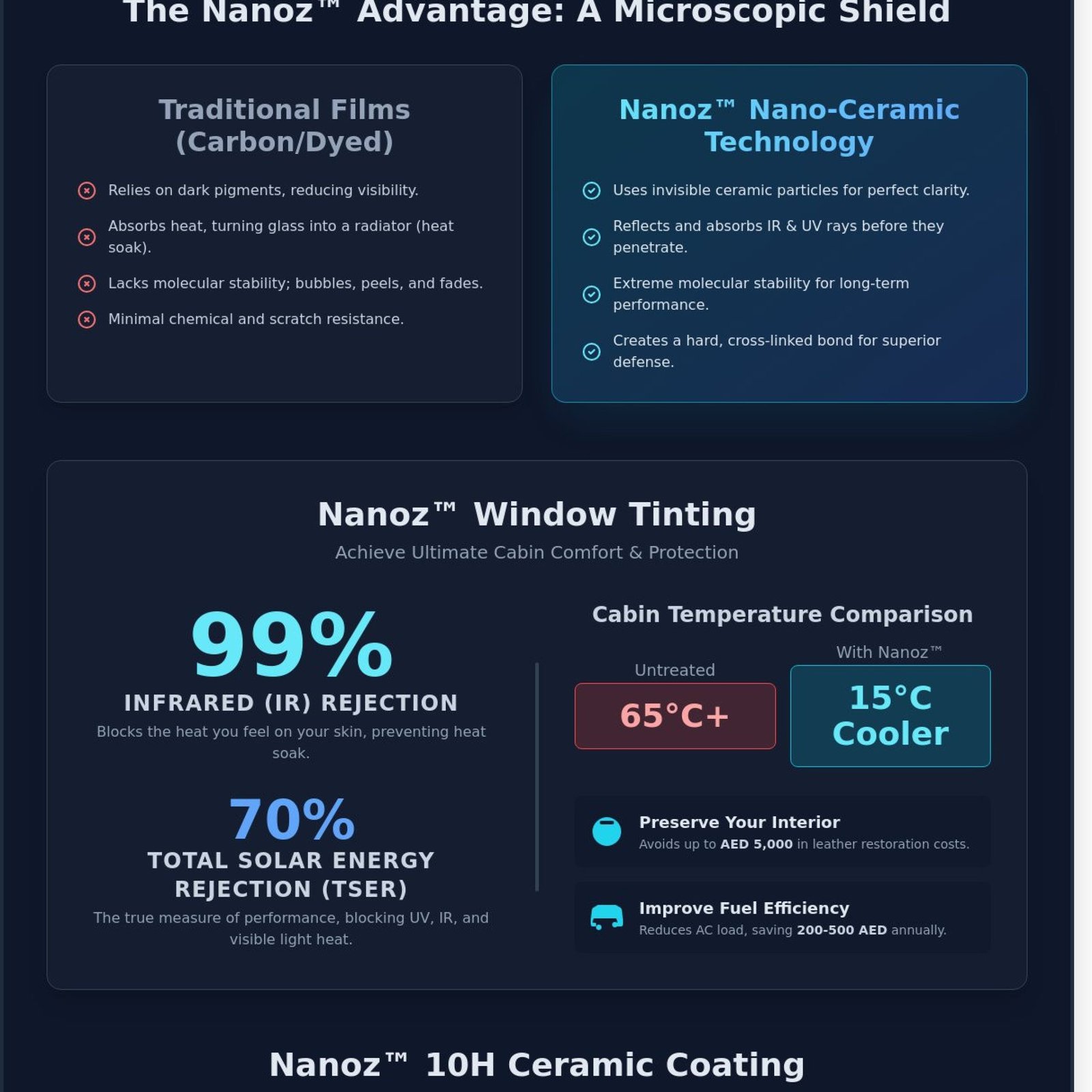
The science behind nanoz technology is what sets it apart from the competition. While traditional carbon or dyed films rely on thickness or dark pigments to block light, this advanced solution uses inorganic ceramic particles. These particles are small enough to allow visible light through, maintaining perfect clarity, but they’re specifically tuned to reflect and absorb infrared radiation and ultraviolet rays. Standard window film technology often struggles with heat soak, where the glass itself becomes a secondary radiator. Nanoz prevents this by blocking up to 99% of UV rays and a massive percentage of solar heat before it even penetrates the glass or paintwork.
The Dubai climate presents a unique set of challenges that would destroy standard automotive finishes in months. We aren’t just dealing with heat; we’re dealing with a UV index that frequently stays above 11 for most of the year. Standard window tints often bubble, peel, or turn a distracting shade of purple under this intense radiation. They lack the molecular stability required to withstand the Arabian sun. Investing in high-grade ceramic protection isn’t a luxury in this region; it’s a necessary step to ensure your vehicle’s longevity and your own comfort.
The Evolution of Car Protection in the Middle East
The UAE market has witnessed a massive shift in consumer expectations over the last 15 years. Owners have moved away from basic aesthetic upgrades toward high-performance functional solutions. In the early 2000s, a simple dark tint was enough for most drivers. Today, the demand for multi-layer protection has skyrocketed. Luxury and performance car owners now prioritize IR (Infrared) rejection rates over darkness levels. This shift is driven by a deeper understanding of how heat affects vehicle electronics and high-end interiors. Local regulations also favor these high-tech solutions, as they provide maximum heat rejection without needing to exceed legal tint percentages.
Key Benefits of Nano-Ceramic Integration
The most immediate advantage is the drastic reduction in cabin temperature. On a typical July afternoon, a car treated with nano-ceramic technology can stay up to 15°C cooler than an untreated vehicle. This provides more than just comfort; it preserves the integrity of premium materials. Nappa leather, Alcantara, and delicate dashboard plastics are prone to drying and cracking when exposed to 60°C+ internal temperatures. By keeping the cabin cooler, you also reduce the load on your air conditioning system. This can lead to a measurable improvement in fuel efficiency, potentially saving you between 200 AED to 500 AED in fuel costs annually, depending on your driving habits. It’s a precision-engineered solution for a demanding environment.
Nanoz Window Tinting: Achieving 99% Heat Rejection in Dubai
The sun in Dubai is relentless. It doesn’t just brighten the day; it penetrates glass and bakes your vehicle’s interior to temperatures exceeding 60°C during peak summer months. To combat this, understanding the technical difference between Total Solar Energy Rejection (TSER) and Infrared (IR) Rejection is vital. Many budget tint shops advertise high IR rejection numbers to mislead customers. IR rejection only accounts for a portion of the heat you feel on your skin. TSER is the true metric of performance, as it measures the combined rejection of UV rays, visible light, and infrared radiation. Nanoz window films are engineered to deliver a TSER rating of up to 70% while maintaining 99% IR rejection, providing a cooling effect that standard dyed films cannot match.
Achieving this level of thermal protection doesn’t require “limo tint” darkness. Older technology relied on heavy carbon or dye layers to block heat, which severely compromised visibility. Modern nano-ceramic technology uses microscopic particles that are invisible to the naked eye. These particles specifically target heat-carrying wavelengths while allowing visible light to pass through. This allows you to enjoy 99% heat rejection even with lighter shades. While many owners prioritize aesthetics, the primary function of high-end window films and ceramic coating for cars is long-term surface preservation and occupant comfort.
Optical clarity is a safety requirement for night driving in Sharjah and Dubai. Cheap tints often cause a “hazy” effect or internal reflections when passing under streetlights. Nano-ceramic films offer a refractive index similar to glass, ensuring your view remains crisp and distortion-free. Durability is another area where nanoz excels. Standard films often turn purple, bubble, or peel after 12 months of exposure to the UAE’s intense UV radiation. Because nano-ceramic layers contain no organic dyes, they’re chemically stable and won’t fade or degrade over time. If you want to ensure your vehicle remains a sanctuary of cool, you can explore our precision tinting packages designed for the Gulf climate.
Signal Clarity and Electronics Compatibility
Metalized films are outdated relics in the age of connected vehicles. These older films use metallic flakes to reflect heat, which creates a Faraday cage effect inside your cabin. This interferes with 5G mobile signals, GPS accuracy, and even your Salik tag or E-ZPass transponders. Nano-ceramic films are entirely non-conductive. Testing shows zero signal attenuation, meaning your navigation stays precise and your calls never drop. This electronic transparency is essential for modern luxury cars that rely on seamless external connectivity for over-the-air updates and safety features.
Choosing the Right Tint Percentage (VLT)
Visible Light Transmission (VLT) determines how dark your windows look. In the UAE, balancing privacy with legal regulations is key. A 30% VLT is a popular choice for side windows, offering a sleek look without hindering the driver’s view. For rear windscreens, some prefer 50% VLT to maintain maximum visibility during night maneuvers. Because the heat rejection technology is embedded in the ceramic layer, a 50% VLT film from a premium brand often outperforms a 5% “dark” film from a low-quality competitor. This allows for customized solutions where every window provides maximum protection regardless of the shade.
Nanoz 10H Ceramic Coating vs. Standard Protection
The jump from 9H to 10H hardness represents a significant evolution in paint protection technology. While 9H was the industry standard for years, 10H products like nanoz offer a denser molecular structure that provides superior resistance to the specific environmental stressors found in the UAE. This isn’t just a marketing label; it refers to the pencil hardness scale where 10H sits at the absolute peak of scratch resistance for clear coats. You can explore the science of nano-coatings to understand how SiO2 and SiC nanoparticles create a permanent covalent bond with your car’s surface, effectively becoming a second skin that’s harder than the factory paint itself.
In Dubai’s unique climate, chemical resistance is a necessity rather than a luxury. The Ghaf tree, while beautiful, produces a highly acidic sap that can etch into a standard clear coat in less than 48 hours under the 45°C sun. Standard waxes or sealants evaporate when surface temperatures hit 65°C, leaving your investment vulnerable. A 10H coating acts as a sacrificial barrier, neutralizing these acids and resisting the harsh alkaline chemicals used in many local “bucket and rag” car washes. It ensures that bird droppings and industrial fallout don’t leave permanent scars on your bodywork.
10H Hardness: The Ultimate Sandstorm Shield
Sandstorms in the Emirates can reach wind speeds of 50 km/h, turning fine desert dust into an abrasive sandpaper. Nanoz 10H technology is specifically engineered to resist the micro-scratching caused by these high-wind events. We apply the coating in a meticulous, multi-stage process to ensure a thickness of 2 to 3 microns. This added depth provides a cushion that absorbs impacts that would otherwise cause swirl marks. While a premium carnauba wax might last 12 weeks, a professionally applied 10H coating maintains its structural integrity for 60 months, making it a far more cost-effective choice for long-term value retention.
Hydrophobic Properties and Maintenance
The “Lotus Effect” is the most visible benefit of a premium ceramic treatment. By creating a surface with a water contact angle exceeding 110 degrees, moisture and liquid grime simply cannot grip the paint. In a city where construction dust is constant, this hydrophobicity means that 70% of surface contaminants can be rinsed away with a simple pressure wash. You’ll find yourself visiting the car wash half as often, saving you roughly 1,200 AED to 1,800 AED per year in maintenance costs. To keep the coating at peak performance, we recommend a pH-neutral maintenance wash every 14 days and a professional decontamination every 6 months.
Beyond protection, the aesthetic transformation is undeniable. A 10H coating functions like a permanent magnifying glass for your paintwork. It fills microscopic imperfections in the clear coat, which increases light reflection and creates a “wet look” gloss that wax simply can’t replicate. This mirror-finish doesn’t just look better; it protects the color pigments from UV oxidation, preventing that dull, faded appearance common on older vehicles in the UAE. Investing in this level of detailing ensures your car looks like it just rolled out of the showroom, regardless of how many kilometers you’ve driven across the Emirates.
Professional Installation: Why the Best Film Needs the Best Detailers
Buying the highest quality material is only half the battle. In the UAE, the environment is exceptionally hostile toward automotive surfaces. Sand, salt air, and extreme UV radiation are constant threats. If you invest in a premium product like nanoz, you can’t afford to cut corners on the installation process. A poor application leads to bubbling, peeling, or trapped contaminants that turn a luxury upgrade into a visual failure. Professional installation isn’t just about sticking film to glass; it’s about controlled environments and technical mastery.
Dust is the primary enemy in Dubai and Abu Dhabi. Professional detailers use pressurized “Clean Rooms” equipped with HEPA filtration systems. These systems keep airborne particles at 0.5 microns or smaller away from your vehicle. Without this controlled atmosphere, microscopic desert sand gets trapped under the film. You’ll see “silvering” or tiny white bumps within 48 hours of the car hitting the sun. These defects aren’t just ugly; they compromise the adhesive bond and reduce the lifespan of the protection.
Precision matters when protecting your car’s trim and seals. We avoid the traditional “hand-trimming” method where a technician runs a blade along your window’s edge. This technique carries a 15% higher risk of scoring the glass or cutting into delicate rubber seals. These micro-cuts often aren’t visible until the seals begin to degrade or rust spots appear three years later. High-end shops use digital plotters to pre-cut the film to the exact specifications of your vehicle’s make and model, ensuring a 100% accurate fit without a blade ever touching your paint.
Temperature and humidity control are vital during the curing process. Adhesive requires a stable environment between 22°C and 25°C to bond correctly to the substrate. In the UAE, outdoor humidity can fluctuate between 40% and 90% in a single day. If a car leaves the shop too early, moisture trapped under the nanoz film expands rapidly in the 50°C heat, causing “fingering” at the edges. Professional detailers keep the vehicle in a climate-controlled bay for at least 12 to 24 hours to ensure the chemical bond is permanent.
Legal Tinting Percentages in the UAE 2026
RTA regulations for 2026 remain strict to ensure road safety across the Emirates. Private vehicles are permitted a maximum of 50% VLT (Visible Light Transmission). This allows for excellent heat rejection while maintaining clear visibility for the driver. Commercial vehicles must stick to 30% or lower depending on their specific permit types. Every installation we perform includes an official RTA-compliant certificate. This document is mandatory for your annual vehicle inspection at Tasjeel or Shamil centers. We ensure your car stays legal while maximizing solar protection. For comprehensive guidance on navigating these regulations while achieving optimal protection, explore our detailed car window tinting in Dubai and Abu Dhabi premium selection guide.
The Dad Auto Care Detailing Standards
We don’t just apply film; we prepare the surface for a lifetime of performance. Our process begins with a 7-stage decontamination to remove industrial fallout, brake dust, and microscopic sand. Our technicians undergo 200+ hours of specialized training for high-performance nano-materials. Every car undergoes a final inspection under 5000K LED lighting to ensure a flawless finish before handover. We provide a written quality guarantee because we believe in the longevity of our craftsmanship.
Protect your investment with the experts at Dad Auto Care today.
Premium Car Care at Dad Auto Care: Your Local Nanoz Experts
At Dad Auto Care, we don’t view car detailing as a chore. It’s a precision art form. Our team operates with a strict detailing mindset, which means we focus on the microscopic details that others ignore. We understand that your vehicle is one of your most significant investments. Preserving its factory finish in the harsh UAE climate requires more than a simple wax. It demands the advanced molecular protection that only nanoz technology provides. Every project begins with a deep decontamination process to ensure the surface is immaculate before we apply any protective layers.
Convenience shouldn’t come at the cost of quality. Our mobile service brings professional-grade protection directly to your driveway in Dubai. We’ve equipped our mobile units with the same high-end tools found in our main studio, allowing us to deliver a showroom finish while you relax at home. This service is particularly popular among busy professionals in Downtown Dubai and Dubai Marina who demand excellence without the downtime of visiting a workshop. We arrive on time, work with surgical precision, and leave your car looking better than the day you bought it.
Our comprehensive protection packages offer a 360-degree shield for your vehicle. We combine three essential services to combat the 50°C summer heat. First, we apply high-performance window tinting that rejects up to 99% of UV rays. Second, we coat the exterior with nanoz ceramic layers for a permanent high-gloss finish. Finally, we treat the interior leather and fabrics with specialized sealants. This holistic approach ensures that every inch of your car remains resilient against sand, salt, and sun. Statistics from our 2023 client reports show that treated vehicles maintain a 25% higher resale value compared to unprotected counterparts in the local market.
Beyond Cars: Home and Marine Nanoz Solutions
The same advanced heat-rejection technology we use for cars works wonders for Dubai villas and apartments. We apply specialized window films to residential properties in areas like Palm Jumeirah and Emirates Hills. These solutions can reduce indoor temperatures by up to 8 degrees Celsius. Homeowners frequently report a 15% to 20% decrease in monthly DEWA cooling bills after professional installation. It’s an investment that pays for itself through energy savings while protecting your expensive interior furniture from sun fading.
Our expertise extends to the water as well. We provide marine-grade protection for yachts and boats docked in Abu Dhabi marinas. The Arabian Gulf’s high salinity is incredibly aggressive toward gelcoats and stainless steel. Our marine coatings create a hydrophobic barrier that prevents salt crystallization and oxidation. This reduces maintenance time by roughly 40%, allowing owners to spend more time enjoying the water and less time scrubbing the hull. Whether it’s a 30-foot cruiser or a luxury yacht, we apply the same uncompromising standards of precision.
Get Started with Dad Auto Care Today
We believe in total transparency when it comes to pricing. Every vehicle has different needs, which is why we offer customized quotes based on your specific requirements. Our base ceramic packages typically start at AED 1,200 for compact sedans and go up to AED 3,500 for full-sized luxury SUVs requiring multi-stage paint correction. We provide clear, upfront costs with no hidden fees. Our booking desk is available 24/7 to answer your inquiries and schedule your consultation at a time that fits your lifestyle.
- Sedans: Packages starting from AED 1,200
- SUVs & 4x4s: Packages starting from AED 1,800
- Luxury & Exotic: Bespoke quotes based on surface area and condition
- Availability: Round-the-clock booking and customer support
Don’t wait for the desert sun to dull your paint or crack your leather. Take the first step toward long-term value preservation today. Our specialists are ready to transform your vehicle with the most durable protection available in the Emirates. Protect your investment with Nanoz at Dad Auto Care and experience the difference that a professional detailing mindset makes.
Secure Your Drive with the 2026 Standard of Excellence
Dubai’s climate demands a level of protection that ordinary films and waxes can’t provide. By integrating nanoz technology into your car care routine, you’re securing a 99% IR heat rejection guarantee that’s essential for surviving 50°C summers. Our 10H ceramic coating provides a permanent, high-gloss shield that resists desert sand abrasion and intense UV radiation. It’s not just a service; it’s a precision art form designed for long-term value preservation.
Our expert technicians bring these advanced 10H solutions directly to you through our mobile service available across Dubai and Abu Dhabi. We’ve mastered the meticulous application process so you can enjoy a showroom finish every day. You’ve invested in a premium vehicle, so it’s time to treat it with the professional care it deserves. Let’s elevate your driving experience with technology that’s built for the future of the UAE roads. Your car is an extension of your lifestyle, and we’re here to ensure it remains in pristine condition regardless of the elements.
Book Your Premium Nanoz Installation in Dubai Now
Frequently Asked Questions
Is Nanoz window tinting legal in Dubai and Abu Dhabi?
Nanoz window tinting is fully legal in Dubai and Abu Dhabi as long as you adhere to the 50% VLT (Visible Light Transmission) limit set by UAE traffic authorities. This 50% threshold applies to private vehicles, while commercial vehicles often face stricter 30% limits. Our technicians ensure every installation meets RTA and police regulations. Choosing a legal tint level prevents fines and ensures your vehicle passes its annual registration inspection without issues.
What is the difference between 9H and 10H ceramic coating?
The primary difference lies in the pencil hardness rating, where 10H offers 15% more scratch resistance and greater durability than the industry standard 9H. While 9H provides excellent protection, a 10H Nanoz coating creates a thicker, more resilient sacrificial layer against the UAE’s harsh sand and UV rays. This increased density means the surface remains immaculate for longer. It requires fewer maintenance top-ups over a five-year period compared to softer coatings.
How long does a Nanoz ceramic coating last in the UAE climate?
A professional Nanoz ceramic coating typically lasts between 3 and 7 years in the UAE climate depending on the specific product line selected. The extreme 50°C summer heat and high humidity levels in Dubai accelerate wear on inferior products, but our premium formulas are engineered for these conditions. Regular maintenance every 6 months helps preserve the hydrophobic properties. We provide a written warranty for up to 84 months to ensure your investment remains protected against paint oxidation.
Will nano-ceramic tint affect my phone signal or Salik tag?
Nano-ceramic tint won’t affect your phone signal, GPS, or Salik tag because it’s constructed from non-conductive ceramic particles rather than metal. Older metallic films often caused a 20% drop in signal strength, but Nanoz technology allows 100% of radio frequencies to pass through. You’ll enjoy seamless connectivity for your mobile devices and toll gate sensors. This makes it the superior choice for modern vehicles equipped with advanced navigation and communication systems.
Can Nanoz film be applied to home windows to reduce DEWA bills?
Nanoz architectural films can be applied to home windows and can reduce your DEWA cooling costs by up to 25% annually. These films block 99% of UV rays and reject nearly 80% of solar heat, significantly lowering the workload on your AC units during peak summer months. By stabilizing indoor temperatures, you extend the lifespan of your HVAC system. It’s a precision investment that pays for itself through energy savings within 18 to 24 months.
How much does it cost to get Nanoz tinting for an SUV in Dubai?
Professional Nanoz tinting for an SUV in Dubai typically costs between 1,500 AED and 3,500 AED depending on the film series and window count. This price includes a full chemical decontamination of the glass and a precision heat-shrink fit for a seamless finish. High-end ceramic options occupy the upper end of this range but offer 95% infrared heat rejection. We provide a detailed quote after inspecting your vehicle’s specific glass area to ensure total transparency.
How do I maintain my car after a 10H ceramic coating application?
Maintaining your car after a 10H ceramic coating application requires a pH-neutral shampoo and the two-bucket wash method every 10 to 14 days. Avoid automated car washes with abrasive brushes, as these can create micro-marring even on the hardest surfaces. Use a high-quality microfiber drying towel to prevent water spots from the UAE’s desalinated water. Applying a ceramic booster spray every 4 months will enhance the slickness and keep the deep gloss looking like new.
Do you offer mobile installation for Nanoz products in the UAE?
We don’t offer mobile installation for Nanoz products because achieving a flawless, dust-free finish requires a temperature-controlled detailing studio. Applying ceramic coatings or tints outdoors in the UAE wind exposes the surface to sand particles and premature curing from direct sunlight. Our facility uses specialized lighting and HEPA filtration to ensure 100% precision during the application process. This controlled environment is essential for the long-term durability and value preservation we guarantee to every client.